


The first partisan of promoting Albania's image in the global arena, through the introduction of world-famous personalities, was Rrapush Xhaferri. Almost 30 years ago, the general of the Pyramids brought world champion Mario Kempes to Albania to make him coach of Lushnja. But Xhaferi financed it with the money he collected from Albanians.
Three decades later, Albania's image generals have become more sophisticated. They no longer get their money from pyramid schemes, but directly from the man at the top of the power pyramid in Albania.
The Albanian Parliament will vote on July 23 on the government's Normative Act, which gave 4.2 million euros of Albanian citizens' money to the Redcloud company as a local partner in organizing rapper Kanye West's concert in Tirana. So the 140 deputies of the Assembly will be called to vote on an ad nominem law, made specifically for the person in the photo below.

Klodian Makashi, owner of Redcloud
This is Klodian Makashi, the owner of the Red Cloud company, the man who requested financial support from the Ministry of Tourism and Culture.
"The legal entity "Redcloud" has submitted to the Ministry of Tourism, Culture and Sports the request with no. 7330 prot., dated 3.7.2026, with the subject: "Request for priority review of the created situation, assessment of public interest and institutional and financial support to guarantee the realization of the international activity "YE LIVE IN ALBANIA. The need for financial intervention arose as a result of the creation of an objective and unpredictable situation during the organization phase of the activity, which has brought about a significant increase in costs and the need to fulfill some contractual obligations of essential importance for its realization." It is stated in the report of the Normative Act approved by the government.
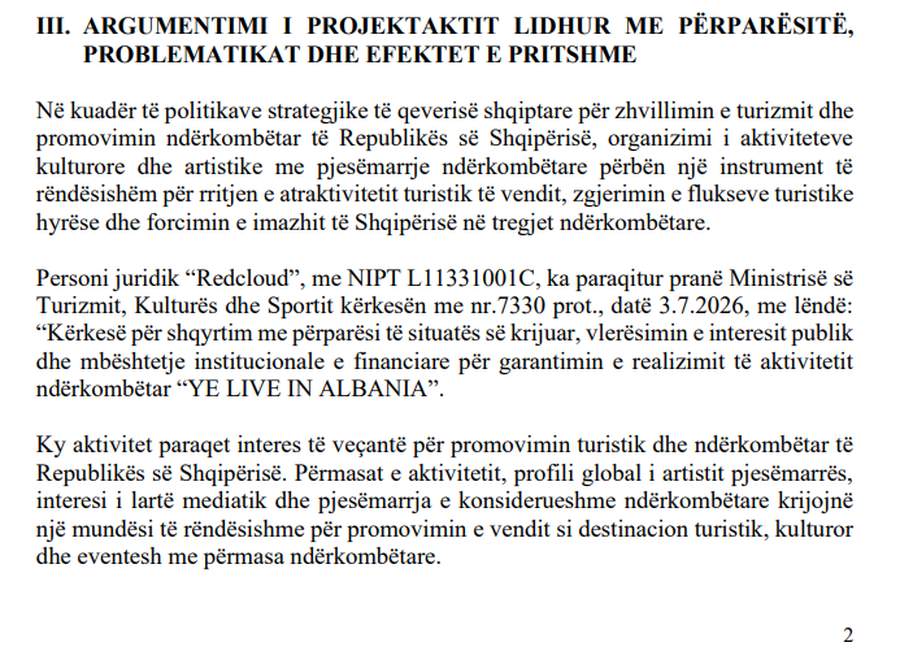
AN's relationship
While the Special Court Against Corruption and Organized Crime isolated the leader of the Democratic Party, Sali Berisha, in his apartment for almost a year for a law that allowed the use of bonds as a payment instrument for privatizations, from which hundreds of thousands of Albanians benefited, Parliament will now vote on a controversial law with a single beneficiary.
This is an absolute precedent in the legislative history of Albania, at least in modern times. Another previous attempt by this majority to make a law ad nominem, which was the case of the Fusha law, failed after being blocked by the European Union. But this time, the law-making on demand broke through every blockade and gave Albania the stamp of a law for a single person.
Setting this dangerous precedent exposes the state budget to similar private demands in the future. Now, any private company engaged in the entertainment business can request money from the budget whenever it brings a foreign celebrity to Albania, and not only. According to legal reasoning, any private business can request this regardless of the field in which it operates, with the argument that the entire economy benefits from its financing.
But this is not the only problem.
Redcloud
Redcloud is an events company founded in January 2011. In the last 4 years, the company's turnover has fluctuated from 370 thousand euros to 1.7 million euros per year. As a result, for the period 2021-2025, the company has had a total turnover for the four years together of 360 million lek, or about 3.8 million euros.
In parallel with this, the company is in a difficult financial situation due to a financial blow of 1.8 million euros suffered a few years ago, when all the equipment it had rented from Greece for a concert in Albania was destroyed as a result of a storm. This is practically a bankrupt company.
So the first question is related to this fact. Redcloud did not have the financial power to organize such an activity. It simply served as the local partner of the German company “Streetlife”, based in Berlin, which is the real organizer of the concert. The question is why Redcloud was used to request and then channel budget money for the financial rescue of the concert.
The government admits that there is no legal basis for financing
The government itself admits that the financing of Kanye West's private concert has no legal basis, as the legal framework in force does not allow the provision of citizens' money without direct procedures for a private activity. For this reason, the solution of the Normative Act, which is a separate law, was found.
"The need is identified firstly on a practical level with the fact that the organization of this event requires support of 400 million lek, without which the event/concert risks failing, based on the communications developed between representatives of the Ministry of Tourism, Culture and Sports and the concert organizers, and secondly on a legal level, due to the fact that in the legislation in force there is no legal basis, a legal authorizing provision, for the issuance of a sub-legal act, to allow the provision of such support, under such conditions for a musical/artistic/cultural event with a pronounced tourist effect," the report states.
Based on Albanian legislation, financial support for activities or projects in the respective fields is provided according to standard procedures extended over time, based on the prior expression of interest of the parties and following the relevant stages of assessment to reach the financing decision-making, as defined in the relevant regulatory sub-legal acts.
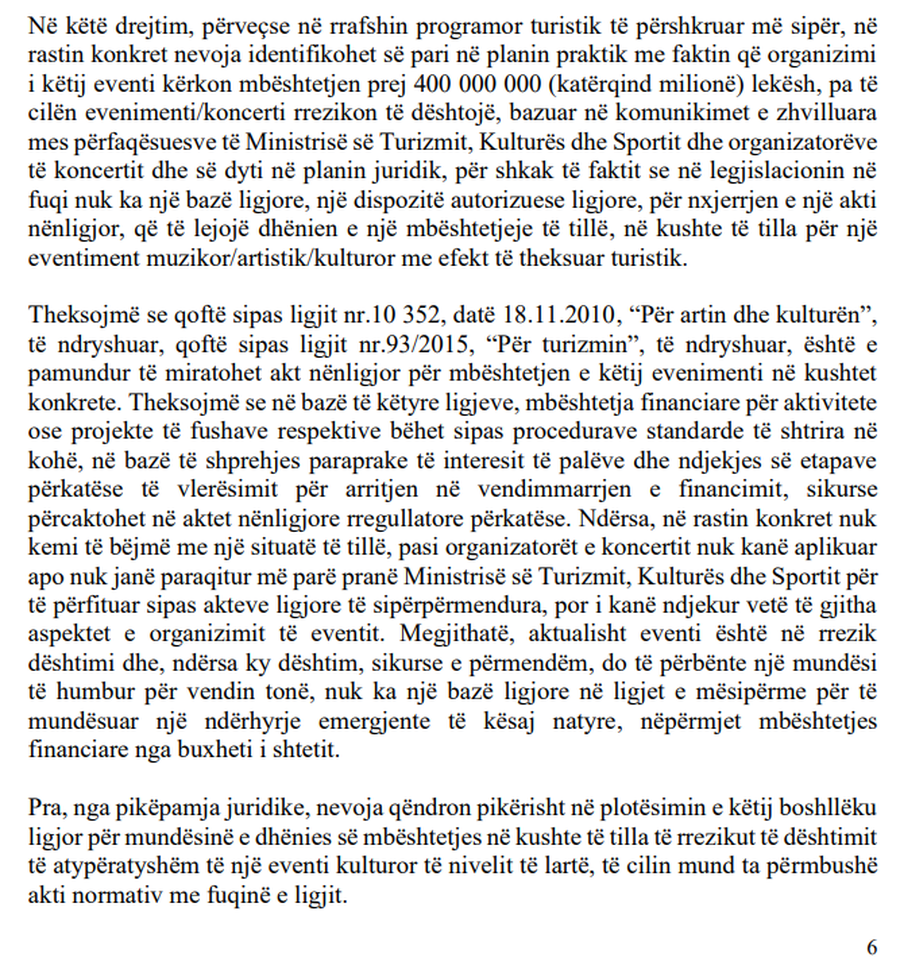
AN's relationship
Whereas, in the case of the Kanye West concert, we were not dealing with such a situation, as the concert organizers did not apply or previously appear before the Ministry of Tourism, Culture and Sports to benefit from the aforementioned legal acts, but requested support with a direct urgent request, arguing with the risk of the concert's failure.
But according to the government, the support is actually for the economy and not for the private sector.
"The need for intervention is not related to supporting a private activity as such, but to protecting the public interest that derives from the economic, touristic and
promotional benefits of the activity. The direct beneficiaries of its implementation are the tourism sector, local economic operators, hotel, transport, gastronomy and service businesses, as well as the state budget through economic activity and the fiscal revenues that are generated," the report continues.


Editorial
