


Every Albanian citizen who carries out transactions in cryptocurrencies, domestically or abroad, will be reported in real time to the Tax Administration.
The General Directorate of Taxation will exchange in real time with the tax authorities of European Union countries data on cryptocurrency transactions carried out by Albanian or European Union citizens.
The obligation stems from a new draft law proposed by the Ministry of Finance. This draft tasks the Tax Administration with monitoring cryptocurrency transactions in real time and exchanging information with European Union countries.
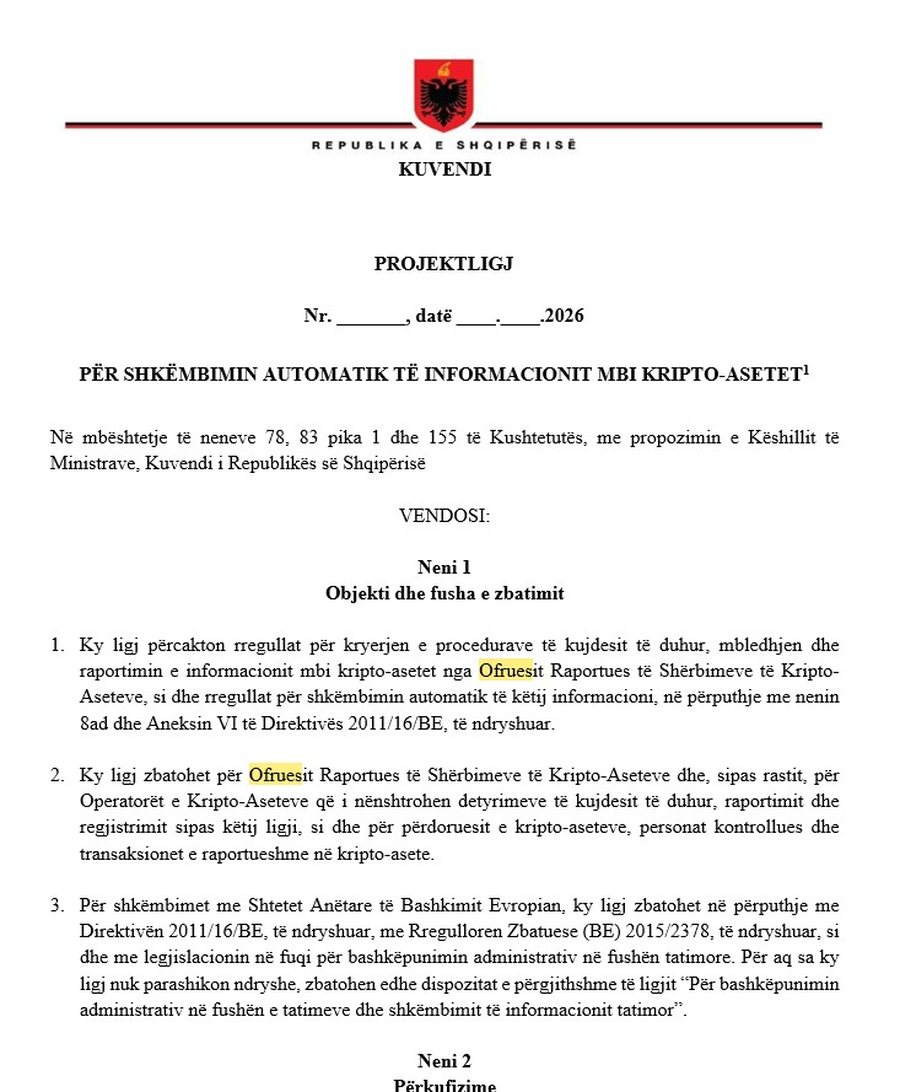
"The draft law addresses the need to create a special legal framework regulating the reporting and automatic exchange of information on crypto-assets, an area that is not covered by the current Albanian legislation on the automatic exchange of information on financial accounts," the draft law states.
Crypto-assets have gained widespread use internationally and their cross-border nature creates opportunities for wealth transfer outside of traditional financial reporting mechanisms.
According to the Ministry of Finance, in the absence of a harmonized reporting framework, tax administrations have difficulty identifying the ownership of crypto-assets and the income derived from them, increasing the risk of tax evasion.
The proposed bill obliges platforms that provide payment or conversion services for Crypto-Assets to implement due diligence procedures, identify reportable users, collect information, and periodically report to the Tax Authority on cryptocurrency transactions.
At the same time, the draft law defines the competencies of the General Directorate of Taxes for the administration of the reporting system, the registration of crypto-asset operators, the control of the fulfillment of legal obligations and the automatic exchange of information with the competent authorities of the member states of the European Union.
Editorial
