



The departure of doctors from Albania and Kosovo towards EU countries is becoming one of the biggest challenges for the health systems of both countries.
A recent report by the European Training Foundation on “Skills for fair and efficient labour migration” shows that the level of potential migration of doctors is very high, especially among the younger generations, with more than half of Albanian doctors and almost two-thirds of Kosovar doctors expressing a desire to leave.
The study is based on surveys conducted during 2023-2025 with 729 doctors in Albania and 310 in Kosovo, as well as on direct interviews with doctors in both countries.
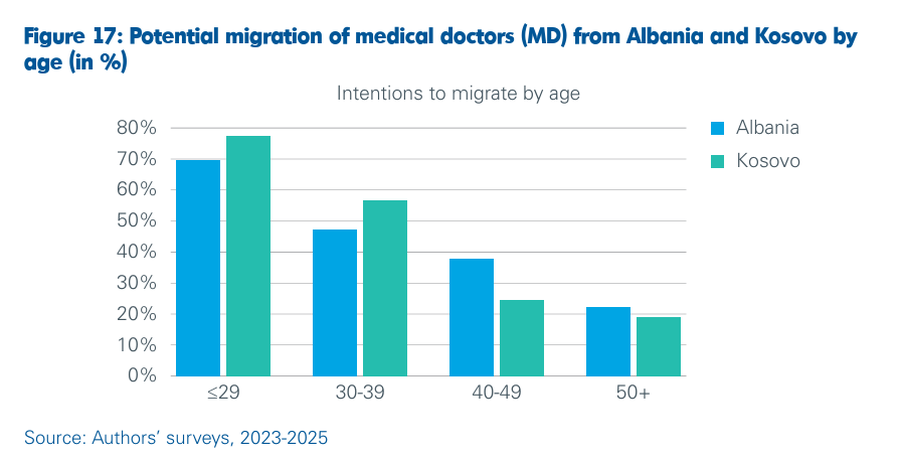
According to the report, 39.7% of doctors in Albania and 46.5% in Kosovo declare that they intend to migrate. The phenomenon is even stronger among the 24-40 age group, where 52.9% of Albanian doctors and 65.7% of Kosovar doctors plan to leave.
Data shows that the tendency to emigrate drops significantly after the age of 40. The report notes that “one in two young doctors from Albania and two in three from Kosovo plan to migrate.”
The peak of the desire to emigrate is among doctors under 29 years old, where in Kosovo the level reaches about 77%, while in Albania it is close to 70%. In the 30-39 age group, the level remains high with about 56% in Kosovo and 47% in Albania. After the age of 40, the percentages drop significantly.
How many doctors can realistically leave?
The report distinguishes between the desire to emigrate and actual potential migration. Analyzing knowledge of foreign languages, contacts abroad and information about host countries, the ETF estimates that 16% of Albanian doctors and 21.4% of Kosovar doctors are classified as “likely to migrate”.
Based on the total number of doctors in the two countries, the report estimates that in the coming years, around 860 doctors could leave Albania and around 730 from Kosovo.
Most plan to leave within three years
According to data on potential migration, 22.7% of Albanian doctors who want to emigrate plan to leave within one year, while 36.9% within the next three years.
In Kosovo, the pace is even faster: 34.5% plan to leave within one year and 42.6% within three years. Only 7.4% of Kosovar doctors say they would leave in the next 10 years, compared to 14.3% in Albania.
The report also shows that 24.4% of Albanian doctors and 15.5% of doctors from Kosovo still remain undecided about the timing of emigration.
The decision to emigrate is made together with the family.
The report's data shows that the decision to emigrate is not just an individual one. In Albania, 49.1% of doctors state that the decision is made together with the family, while in Kosovo this figure is 42.3%.
Meanwhile, 47% of doctors in Albania and 54.2% in Kosovo say they make the decision themselves. In Kosovo, a stronger gender difference is observed: 59.5% of men declare that they make the decision individually, compared to 48.5% of women.
Albania and Kosovo differ in their motives for emigration
The report highlights differences between the two countries regarding the reasons for leaving. For Albanian doctors, economic factors dominate, such as salaries, standard of living and financial conditions. While in Kosovo, the main motives are more related to professional development, specializations and opportunities for advanced training.
Germany and Switzerland are the main destinations for Kosovar doctors, while Albanian doctors display a wider range of preferred countries.
Albanian doctors most likely to emigrate permanently
The report also highlights strong changes in the way the duration of emigration is perceived.
Around 31.6% of potential emigrant doctors in Albania declare that they intend to leave "finally", while in Kosovo this percentage is significantly lower, 17.2%.
In the 24-40 age group, the difference remains strong: 30.4% of Albanian doctors plan permanent emigration, compared to 15.5% of Kosovar doctors.
On the other hand, in Kosovo, plans for temporary emigration "for several years" dominate, with 27.6% of respondents, compared to 19.5% in Albania.
Almost half of doctors in both countries consider emigration an "open-minded" choice, leaving open the possibility of returning depending on economic and professional conditions in their countries.
Editorial
