The government has found a way to procure all public information technology contracts without being subject to public procurement law. In short, without tender. The way is called Albanian Digital Solution, the public company created to replace AKSHI in building and maintaining the country's digital infrastructure.
A recent decision by the Council of Ministers practically creates a monstrous national monopoly in the field of Information Technology, which will be even worse than the National Agency for Information Technology, as it will not be obliged to conduct public tenders, but will set prices according to costs it determines itself.
But how will the scheme work?
All state institutions that need to build new digital systems, maintain or improve existing ones are obliged to submit a request to the National Agency for Information and Communication Technologies (NAI). The latter reviews the submitted request in advance and, in cooperation with the requesting institution, drafts technical and functional requirements, as well as approves the terms of reference or the relevant service specification document.
"After approving the terms of reference or the relevant service specification document, AKSHI forwards the request and relevant documentation to the company "Albanian Digital Solution", sh.a., for the assessment of the possibility of implementing the service," the government decision states.
Within 10 days, ADS is obliged to respond whether or not it can provide the requested service. If it undertakes to provide the service, ADS conducts a detailed analysis of the service, including the cost that the requesting institution will pay to it. Therefore, the price is not determined by competition, but it is ADS itself, as the service provider, which will determine the price that the institutions will pay.
The government decision divides services into four categories and four levels of complexity. For each of them, an operational margin is set, which ADS can charge on the total cost of the service. These margins range from 5 percent to 16 percent, depending on the complexity.
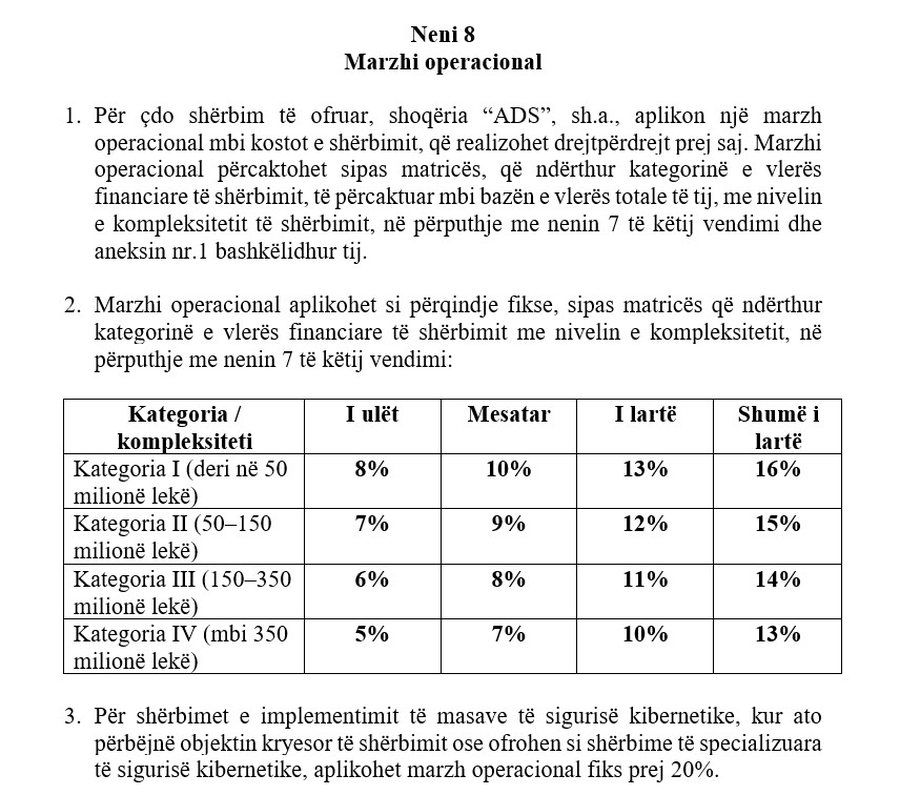
Categories and margins
At first glance, the lack of a tender seems justified because in the end it is always a public company that will benefit from the money, such as ADS. But the trick lies elsewhere. To provide the services required by state institutions, ADS can cooperate with private companies and the way it chooses private companies is at its discretion.
This is the mechanism that distributes public money without a tender to private individuals. Meanwhile, there is another trick. ADS shares can be purchased by private individuals up to 49 percent.
Model
If the Ministry of Finance wants to improve the treasury's electronic system, it submits a request to the National Agency for Public Finance. The latter receives the request and, in cooperation with the Ministry, develops the terms of reference and technical specifications.
After having carried them out, it is addressed to Albanian Digital Solution. It is Albanian Digital Solution that determines in which category the service requested by the Ministry of Finance falls and at what level of complexity. Based on these divisions, ADS derives the total cost that the Ministry of Finance must pay, including the relevant margin.
If the cost is set at 2 million euros, then ADS begins the implementation of the project and, if possible, can take on a private partner in the implementation of this service, which it pays at its discretion, without competition.
But in addition, the government has provided that ADS shares can be freely traded and that private individuals can also become owners of up to 49 percent. This opens another dangerous path. A private individual buys 49 percent of ADS shares and thus becomes the monopolist of the Information Technology market in the country, collecting billions of public money without tenders through ADS.
It is not known whether this type of model exists in any other country. But ADS is practically the creation of a pocket, which takes out budget money without tender and without any legal restrictions, taking it to private parties. A sha, which has an absolute monopoly of the market, sets its own prices and can contract private parties without tenders. This is the ADS monster, worse even than AKSHI.
Editorial