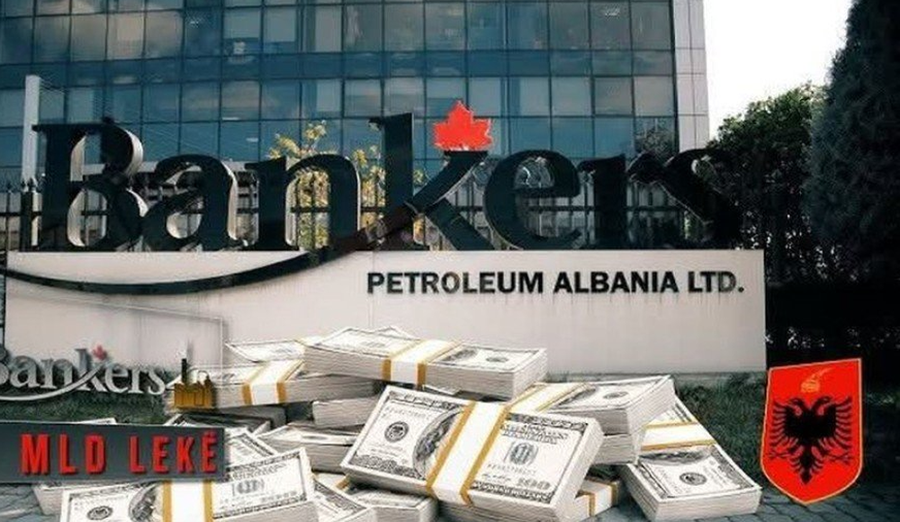
On December 13, 2024, the Fier Court of First Instance of General Jurisdiction ordered Bankers Petroleum to pay around $600,000 in wages to its former director Leonidha Çobo for his dismissal.
With the court decision and the corresponding enforcement order in hand, Mr. Çobo contracted a debt collection agency to collect the debt from Bankers. The agency, called Private Enforcement Group, attempted to find Bankers' money in Albanian banks, but without success.
The Chinese company that has been exploiting Albanian oil for years has not had any active accounts in Albania, in order to avoid being able to execute the numerous debts it has accumulated to private creditors, but also its obligations to the state. For the necessary payments that it had to make within the country, Bankers together with Raiffeisen Bank had launched a criminal scheme, through an overdraft, which according to the law could not be executed by creditors.
Faced with this fact, the bailiffs found another method to get their client's money; they blocked the scrap in the Patos Marinza field. But there was a problem. The scrap did not belong to Bankers, since according to the concession agreement, every asset in the field is state property.
Theft of public property by force
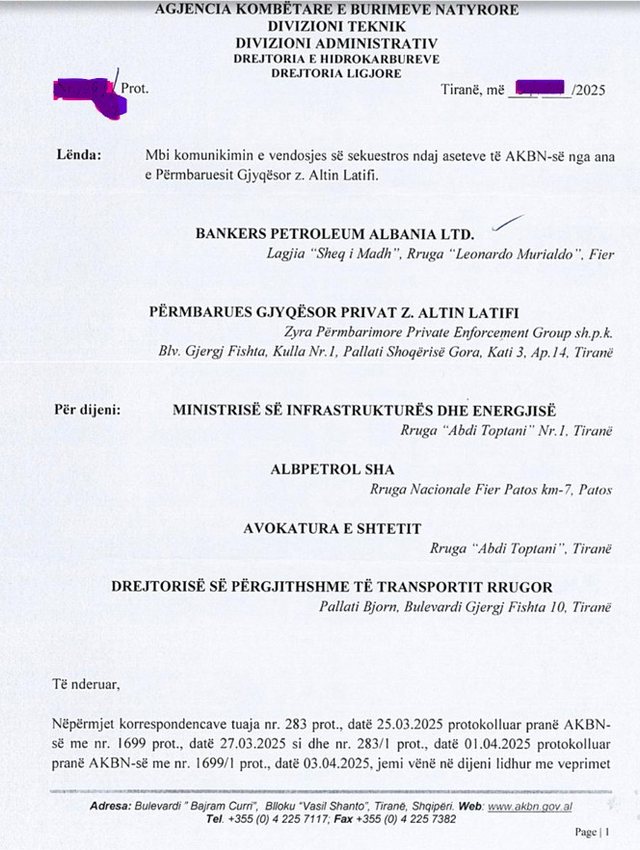
After bailiffs blocked the state scrap metal to sell it in order to get the money that Bankers had to pay its former director, someone notified the institutions. The National Agency for Natural Resources sent an official letter to Bankers Petroleum and the bailiff's office, warning them that the scrap metal was state property and the Albanian state's property rights could not be violated to pay off the company's debts.
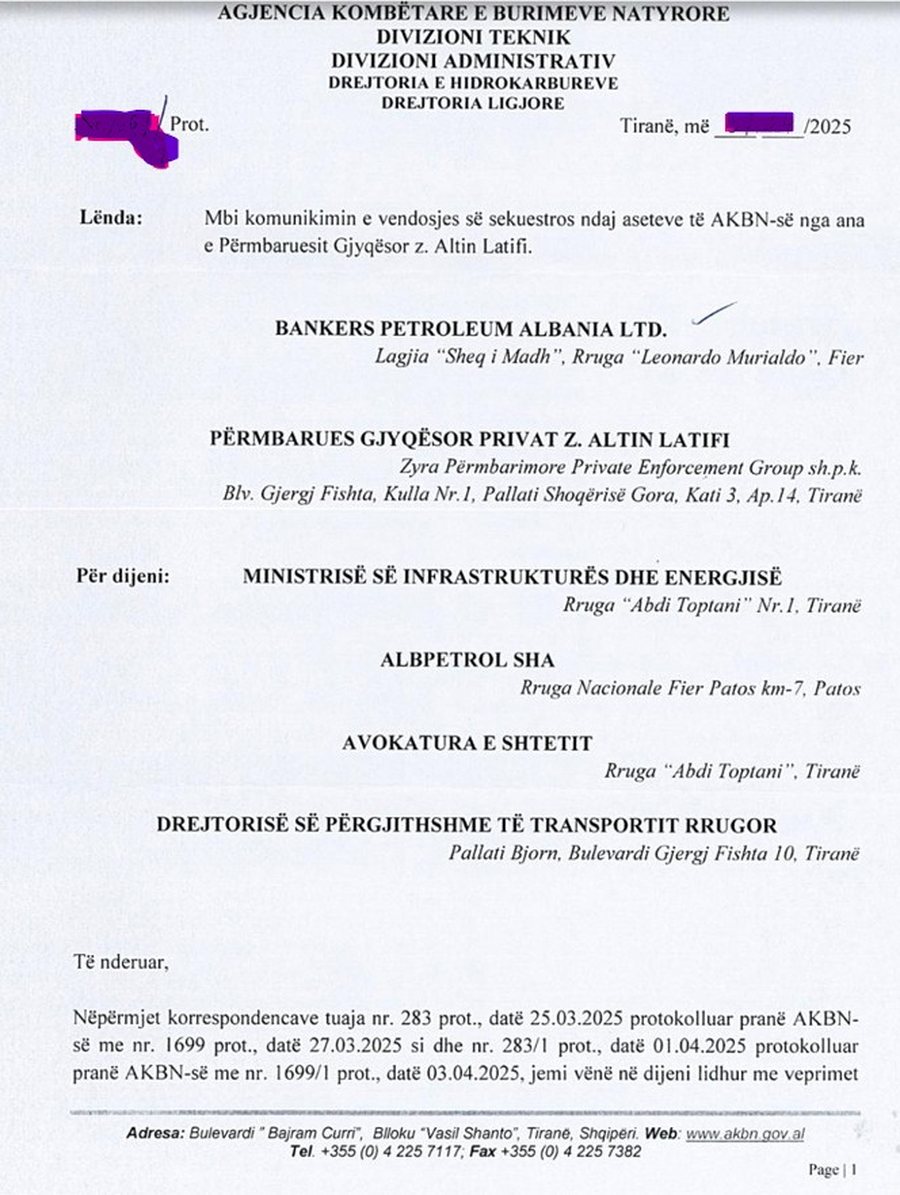
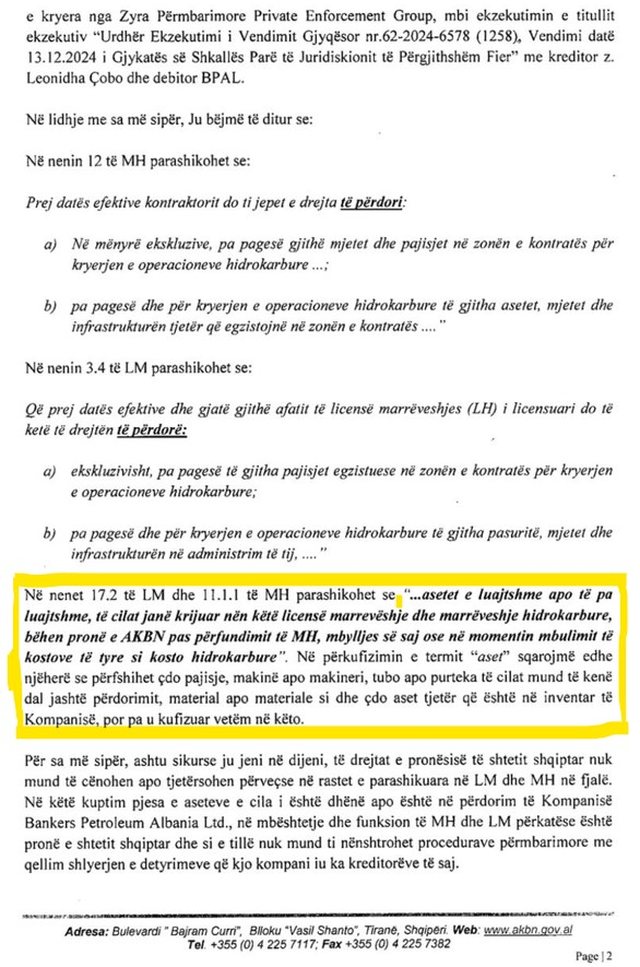
AKBN letter
"Article 11.1.1 of the Hydrocarbon Agreement provides that the movable and immovable assets, which are created in this license agreement and hydrocarbon agreement, become the property of AKBN upon the termination of the hydrocarbon agreement, its closure, or at the moment of their coverage as hydrocarbon costs," it is written in the letter that AKBN sent to Bankers and the bailiff's office.
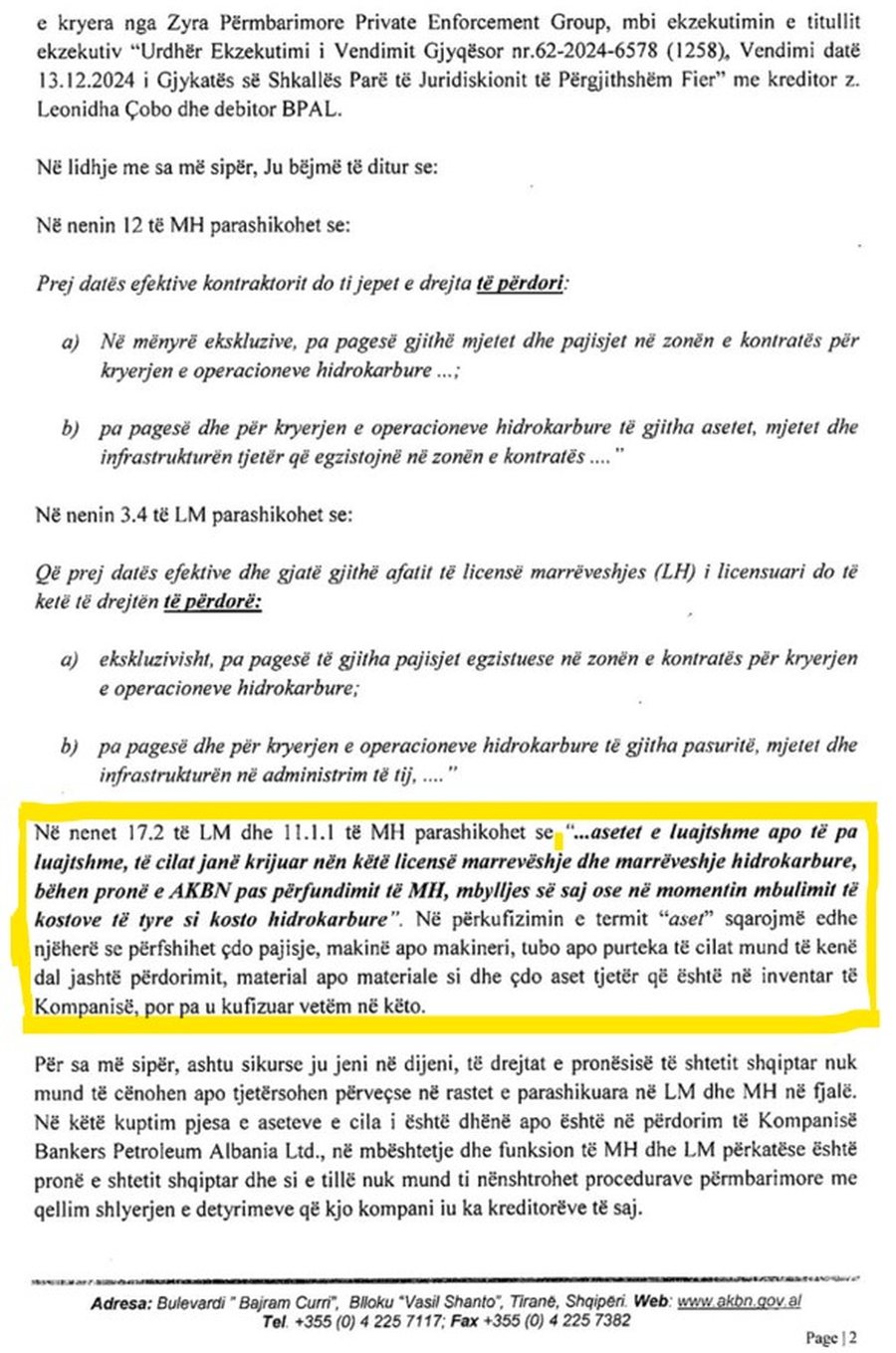
At the end of the letter, AKBN even more explicitly warns the bailiff not to execute Bankers' obligations to his client by selling the scrap, which is state property.
"The part of the assets that has been given to the Bankers Petroleum company for use is the property of the Albanian state and as such cannot be subject to enforcement procedures in order to repay the obligations that this company has to its creditors," the AKBN letter states.
The letter that AKBN sent to the Chinese company and the bailiffs is dated April 7th of last year. But the bailiffs did not put water on the fire at all, even though they were officially warned that they were selling state assets to collect the debts of a private company.
Two weeks after being warned by the AKB, the bailiff held the auction to sell the scrap. The auction itself is another big story of theft.
Theft with the blessing of Bankers executives
Although officially warned by AKBN not to sell the scrap, the bailiff contracted by Leonidha Çobo announced the auction. At its conclusion, the scrap was sold to the company Shkëlqimi 07, a company owned by the former mayor of Ballsh, Shkëlqim Kapllanaj. And the state's scrap was sold for a piece of bread.
Shkelqimi 07 bought the scrap metal at a price half of the market price of this product. The total value of the scrap metal that this company received was 1.2 million euros. But it paid the bailiff only 600 thousand euros, the amount of the debt that Bankers had to pay to Leonidha Çobos.
Two sources well-informed on the matter and independent of each other told Kapital that the sale of the scrap at that price was done with the blessing of the company's executives. After all, Bankers was the one who benefited the most from this theft. It paid its debts by selling state assets.
And this is just one of the endless cases of how Albanians have been brutally robbed in Patos-Marinza. Although in these cases, the theft has been open and bringing the state and the law to its knees.
Editorial