cAPITAL
In March last year, the Special Court Against Corruption and Organized Crime ordered the seizure of over 400 thousand euros worth of assets belonging to Gëzim Çela and his relatives. Among the seized assets were two apartments in Tirana, with areas of 74 and 77.2 square meters respectively.
Ten days later, a SPAK financial investigator and a judicial police officer went to the location of the assets to execute the court decision. But instead of taking the assets and handing them over to the Agency for the Administration of Sequestered and Confiscated Assets (AAPSK), the investigator and the OPGJ drew up a report.
"These two apartments have been merged into one and citizen M.Th. and her 4 children reside in this apartment and for this reason these two apartments were not handed over to the administrator of the Sequestered Assets Agency," the two officials write.
AAPSK had appointed employee Enea Çaushaj as the administrator for the takeover of the assets. The latter, after the written determination by the OPGJ and the SPAK financial investigator in the minutes, did not take any further action to request the execution of the decision. As a result, the two apartments, which should have been transferred to the state in March 2023, are still today in the administration of the family of Çela, otherwise known as the drug baron.
But this is not the only case that proves that the fight against criminal assets is failing. In February last year, the First Instance Court of Elbasan confiscated a 79 square meter premises in the Luigj Gurakuqi neighborhood, which belonged to citizen Edison Gashi, sentenced in Italy to 8 years in prison for the criminal offense of drug trafficking.
The OPGJ in charge of executing the decision, Xhaferr Muha, after going to the location of the property, kept a record in which he wrote that the property in question, located on the second floor, has only one entrance. This entrance is through the first floor, which is in the possession of the judicial subject, Edison Gashi. "For this reason, it was not possible to hand over the property, as it seems impossible to administer it safely by the AAPSK," concluded Muha.
The administrators of AAPSK attempted several times to take possession of the property, requesting the support of the Elbasan Local Police Directorate and the General Directorate of the State Police. However, the police did not respond to the letters.
Toast with an empty glass
One of the most widely touted successes of the Justice Reform and the work of SPAK has been the crackdown on criminal assets. On more than one occasion, SPAK itself has presented figures showing the exponential increase in seizures and confiscations of assets of criminal organizations. But graphs are one thing. And the reality on the ground is another.
An audit report by the Ministry of Interior, in the summer of this year, reveals that 30 percent of assets seized or confiscated by court decisions have not been taken over by the state and continue to remain in the administration of their owners.
"According to court decisions, by June 30, 2025, there are 3,199 assets or evidence that should have been submitted/received for administration. Of these, only 2,261 assets/evidence have been submitted/received for administration by the AAPSK, while 928 assets/evidence have not been received for administration," the audit report reveals.
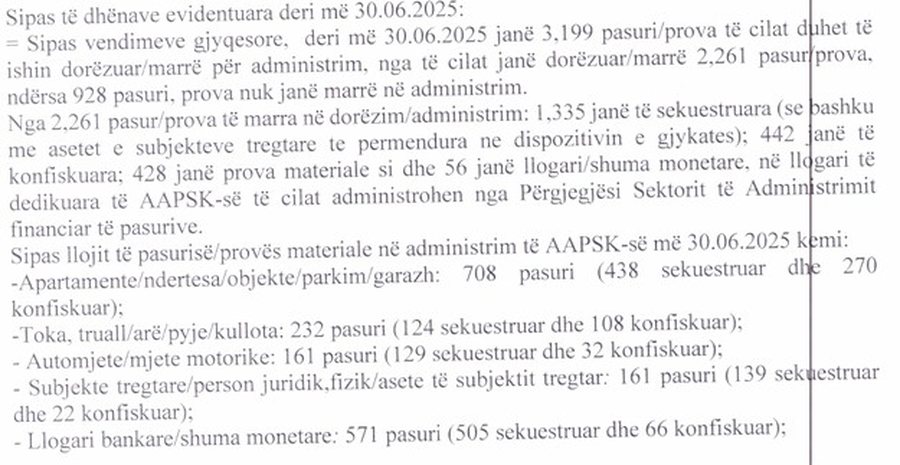
UK audit report
Ledion Boshnjaku, Erjon Kasmi, Saimir Taullau, Eridan Nebiu, Klodjan Llanaj are just some of the names of the criminal world whose assets have been seized by court decisions, but who continue to administer them and have them in their undisturbed possession, since the state has failed to execute them.
According to the audit, those responsible for this failure to recover criminal assets are the SPAK Judicial Police Officers, the State Police, but also the Sequestered and Confiscated Assets Administration Agency. But that's not all.
Another way that criminal assets are escaping the clutches of the state is by playing with banks. Many of the seized assets end up as collateral for loans and end up in the ownership of banks.
The audit report illustrates a series of concrete examples, which makes the decisions to seize them simply numbers on the success charts of the government and SPAK. In short, a toast with an empty glass.
Editorial