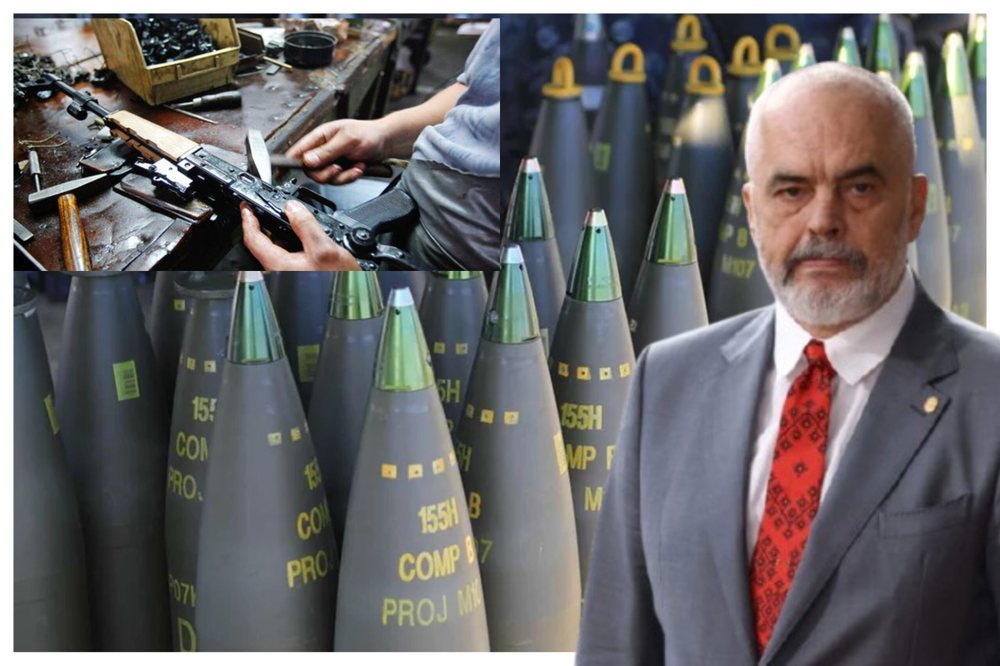
In a new attempt to position itself as a small but ambitious player in the global defense industry, Albania has embarked on a slow but determined process to revive its military industry. The objective is clear: to produce weapons and equipment with the “Made in Albania” stamp, capable of being used by the Albanian army and potentially exported to international markets by 2030.
For years, the military factories of Mjekës, Gramsh and Poliçan, which once supplied the communist regime with weapons, were left to rot under the wild grass and memories of a closed economy. But in April 2024, Prime Minister Edi Rama publicly announced the ambition to revive domestic military production and turn Albania into a potential arms exporter within a decade.
"Our ambition is that by 2030 we will also have military exports of the "Made in Albania" brand and on the other hand, of course, our army will also begin to be equipped with military equipment of the "Made in Albania" brand. - EDI RAMA PRIME MINISTER OF ALBANIA, 03.04.2024
This political promise was followed up with several steps. The government approved the law for the creation of a state-owned company that would deal exclusively with the production and trade of weapons, ammunition and military equipment. The company “KAYO” jsc, founded later that year, was tasked with the mission of reviving a vanished industry.
Since the first months of its existence, KAYO took over the physical spaces of three historical factories in the country, such as the Explosives Plant in Mjekës, the Mechanical Plant in Gramsh, and is now in the process of taking over the Mechanical Plant in Poliçan. At the same time, by Decision of the Council of Ministers, the former Vehicle Parts Plant in Tirana and the former Copper Processing Plant in Rubik were also transferred to KAYO.
During this time, KAYO told FactFinder that it has signed five memorandums of understanding with large international companies that are global players in the production of military technologies and systems. However, the content of these memorandums remains confidential due to confidentiality and industrial secret agreements and that they will be made public at the time of the creation of joint ventures to launch production activities – KAYO explains.
Meanwhile, the government has allocated a number of funds to support this industrial revival. So far, 440 million lek have been allocated in two directions: on the one hand, to repay the historical debts of the factories to employees and municipalities, and on the other hand, to establish the legal and organizational structure of KAYO. On the other hand, the budget has also financed the company's own expenses. For 2024, 150 million lek have been disbursed from the Ministry of Defense budget for this enterprise, while for 2025 an equal amount has been foreseen, which is expected to be paid in the coming months according to the response that the Ministry of Finance gave to Fakt.
However, big questions remain. Is the ambition to export Albanian weapons within the next five years achievable?
For Colonel Dritan Demiraj, the project is of national importance and as such is welcome, but propaganda is not enough. “Serious investments are required, professionalism and transparency are lacking, as well as cooperation with prominent companies,” says former Interior Minister Demiraj. He emphasizes that the project should start with the production of infantry weapons, clothing and logistics for the Armed Forces. “Within 2-3 years, with serious investments, this is feasible,” he estimates.
In fact, KAYO's efforts to revive this industry so far have been limited to working to establish a flight school in Vlora — which is expected to train pilots, instructors, and technicians — to negotiating the production or adaptation of special motor vehicles, or to the production of military clothing and accessories.
For his part, the former commander of the Naval Forces, Captain First Rank Artur Meçollari, sees the military industry not only as an element of security, but also as an economic opportunity. He raises doubts about the sustainability of defense policies in Albania. As an example, he brings up the severance of cooperation with companies such as “Lockheed Martin” – the company that built and maintained the air and sea surveillance system – and “Damen Shipyards” – the Dutch shipbuilding company – thus questioning the country’s credibility in the international arena.
"Just one year after taking office, Minister Vëngu has reoriented all partnerships, significantly reducing Albania's credibility with strategic partners and compromising operational readiness," says Captain Meçollari, who warns that without strong cooperation and political stability, the project cannot move forward.
In terms of budget, Albania has fulfilled its commitment to NATO to spend 2% of Gross Domestic Product on defense, a standard that was met for the first time in 2024. In the 2025 draft budget, the Ministry of Defense is expected to receive 52.6 billion lek, which constitutes exactly this 2%.
Despite this, the leap towards export remains a major challenge in Artur Meçollari's view as the global arms market is strictly regulated and influenced by geopolitical developments. "Albania cannot revive the industry without strong partners, and first it must regain credibility as a serious and safe country," Meçollari concludes.
According to Demiraj, Albania should also look to the countries of the region for cooperation, as according to him, "the potential exists not only to cover Albania's needs, but also to export infantry weapons, and in the future also combat systems such as drones or artillery, by cooperating with countries such as Kosovo, North Macedonia and Croatia." Meçollari also emphasizes that "Albania and Kosovo should cooperate for common needs in the modernization and equipping of their respective structures and avoiding competition between them.
But the government and the Ministry of Defense must be serious, Demiraj believes, since the only way to enter international markets is through the production of quality materials and weapons, which are now easily testable. For now, the effort looks more like an industrial project with strategic and symbolic value than a near-term source of income. But at a time when security in Europe is once again in question and countries are seeking greater diversification of supply sources, Albania could find a place in this new landscape — if it sees through the projects it has started.
Editorial