The price of copper in international markets has reached a record high, exceeding $13,000 per ton. Data from stock exchanges shows that in the space of a year, the price of copper has increased by 50 percent, due to supply disruptions and high demand.
But as prices skyrocket, Albanians see almost no benefit from their underground wealth, as the companies that have concessions to mine copper leave behind only financial losses and terrible pollution that has destroyed entire villages.
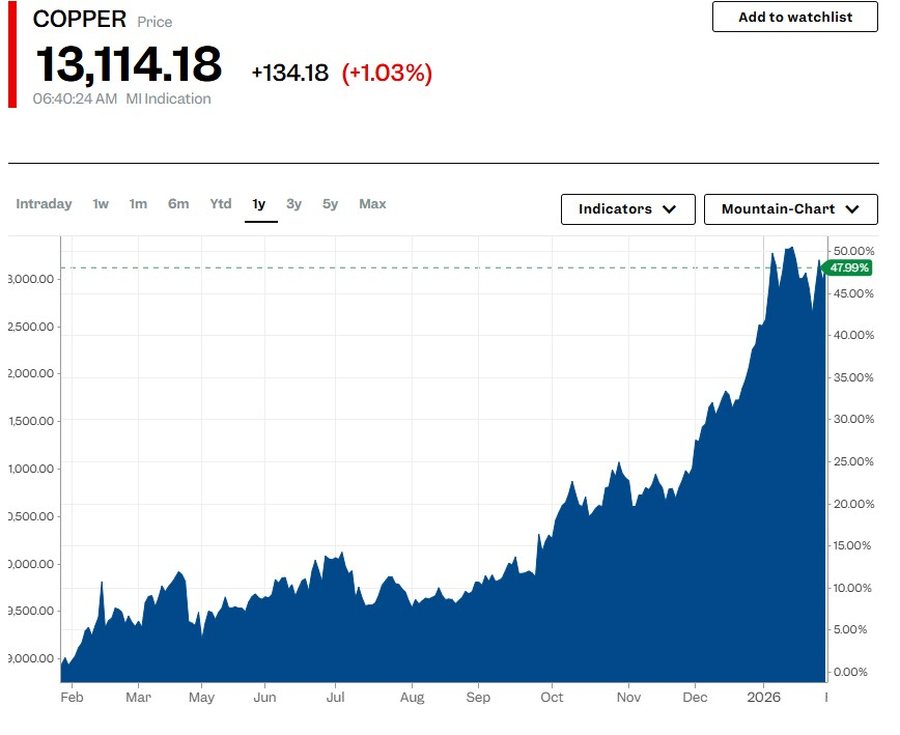
Copper price in international markets
The largest copper concessionaire in Albania is a company called Beralb. Its shares are owned 50 percent by Turkey's Ekin Maden and 48 percent by China's Jiangxi Copper, while the remaining 2 percent is owned by two other Chinese companies.
Official data from the Tax Office shows that in the last 11 years, Beralb has declared 8 years of significant losses and in three other years negligible profits. For 2024, the company closed its financial result with a negligible profit of 1.75 million euros, although it collected a full 35 million euros from the sale of Albanian copper abroad.
Expenditure inflation for concession companies is not an unknown phenomenon for Albania, but in the case of extractive industries, tax evasion is the least of the problems. Another major problem is that of the destructive pollution they cause.
Destruction of villages
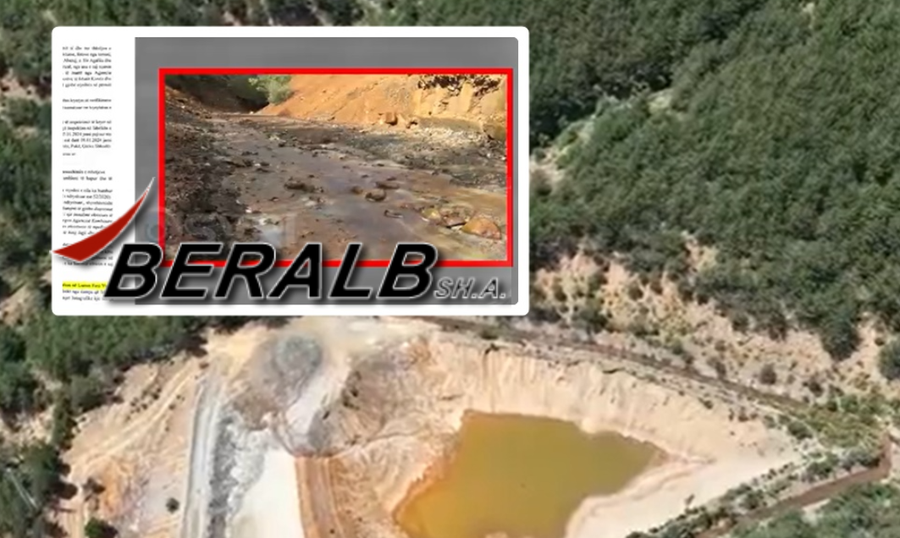
In early 2024, the National Inspectorate of Environmental Protection appeared at the doors of the Beralb factory in Fusha Arrëz after a complaint from the residents of the villages of Kimëz and Kalivar, about the pollution of the flow of the Kimëz stream and the Fan river. The violations found are numerous, as is the factual situation.
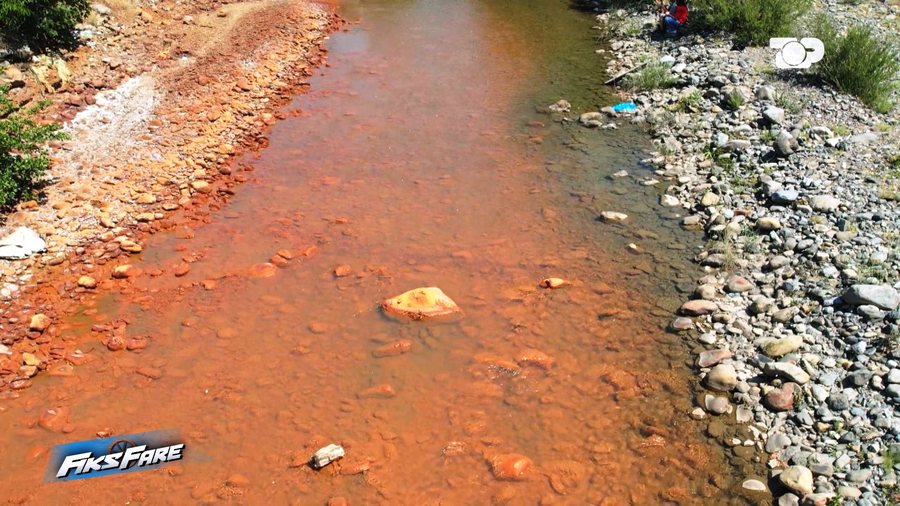
The copper enrichment company, Beralb, had neither a permit to use water resources, nor a permit to discharge water, nor a contract for the management or transfer of waste, which was dumped in an open and undifferentiated environment. While the environmental permit that was shown to the inspectors, belonged to the distant year 2011, which had lost its legal effects.
The inspectors' description of the situation at the factory was even more dramatic.
"In the open environment, in the Micoj stream, which then flows into the small Fani river, polluted waters were continuously discharged that came indirectly from the dump that the factory uses for the disposal of polluted waters. This pollution was quite pronounced and large. It had also changed the natural color of the waters of this stream, giving it the bronze color of copper ore. The waste that should have been deposited, in a controlled and differentiated place, was abandoned, thrown in different spaces and mixed outside any kind of environmental conditions" - stated the report of the National Inspectorate of Environmental Protection
The inspectors imposed 5 fines for a total of 10 million lek, demanding the immediate suspension of the activity. Also because the company "has committed these violations before and is a repeat offender."

Mehmet Uluyurt, CEO of Beralb
The measures were confirmed in February 2024 by the Administrative Appeals Commission. But in the meantime, the Beralb company had put the Administrative Court in motion. For months, a long confrontation took place between the parties and in the end, Beralb managed to resume work again.
Pollution 7 times above the norms
As part of an environmental project by Green-Al, implemented by the Center for Transparency and Free Information, together with 2 other organizations, measurements were carried out in Fushë-Arrëz last summer, both of water and soil. The project, which is supported by the Swedish government, also included areas of the mining industry in Has. Focusing on the case of the copper enrichment factory in Fussha Arrëz, the measurements resulted in concerns.
The presence of iron in the water in this area was documented to be 7 times higher than EU norms, aluminum 4 times higher, and lead more than twice the norm.
Long-term exposure to these metals poses a serious risk to public health, as these polluted waters can also contaminate groundwater, which would be fatal for residents who then use it as drinking water.
"From the results obtained, in two of the points the waters are polluted. The analysis of the sludge, for iron is 7 times higher than the level allowed by the European Committee, aluminum, lead, which are heavy metals and have a great effect on the quality of the water. The levels are high, heavy metals have a negative impact on the quality of the water, but also on living things. Their impact on living things is great, but those surface waters tomorrow could pass through environments or terrains that would also contaminate groundwater. Those waters could also be used as drinking water, and this would be fatal", declares Prof. Dr. Sokol Abazi, part of the working group that made the measurements.
The long-term exposure to the alarming pollution that Beralb has caused in the Fushë Arrëz area has led to the destruction of entire villages like Kimëz and Kalivar. While farmers see their land continuously contaminated and with it the destruction of their daily lives, billions in their underground wealth are flying to Turkey and China.

Editorial