The crackdown on the criminal organization within AKSHI and the seizure of 40 million euros in assets by SPAK constitute one of the most sensational and positive actions of SPAK. The dismantling of the AKSHI swamp, which the Prime Minister described as digital pride, stops at least temporarily the terrible financial bloodshed that this institution has caused to Albanian citizens.
But the investigation and the materials submitted by SPAK to the court the day before leave several key questions unanswered. At the center of them is a 17 million euro tender for smart laboratories in 216 schools across the country.
This tender is the reason that forced SPAK to indict its main contractor for information technology services, the company Albascan. Awarding tenders to a company that was part of the criminal organization in AKSHI was an own goal for SPAK itself, especially since the Special Prosecution Office had public indications that Albascan was tainted by corruption.
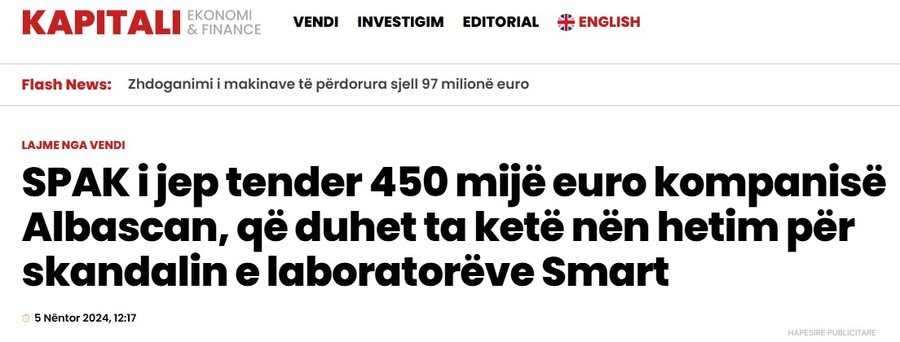
However, this is another issue. Now let's get back to the point. What is the tender for smart laboratories in schools?
The tender with a fund limit of 1.67 billion lek envisaged equipping 216 schools across Albania with laboratory classes, which would have 14, 17 or 19 laptops each, respectively, as well as wireless internet. On average, 80 thousand euros for a laboratory class or 4700 euros for a laptop along with auxiliary equipment. The figures clearly show the bloodshed. ( Read here. )
Albascan and its owner, Elision Jorgjis, were indicted by SPAK after the testimony of citizen Migena Schroeder. The latter, former owner of the company AESS, testified before prosecutors that the laboratory tender was a robbery with a predetermined winner, the company Albascan and her company AESS as subcontractors. Ms. Schroeder's company would provide wireless internet, while Albscan would provide laptops and the work to install them in the classrooms.
According to the SPAK file, Albascan, after receiving 17 million euros from AKSHI, passed on the corresponding share to Schroeder's AESS plus 1.1 million euros in corrupt payments, which Schroeder, according to her testimony, then passed on to Ergys Agas's company under pressure as a bribe. But this is only part of the truth. The full truth is different.
The real beneficiary of the 17 million euro tender for the laboratories was the company Advanced Business Solutions, owned by businessman Gerond Meçe. Albascan was appointed the winner of the tender as a pre-emptive move by the trio Karçanaj, Shima, Meçe because at the time the tender was publicly rumored to be corrupt and biased towards the Meçe company. Gerond Meçe also included Schroeder in the tender.
Consequently, most of the money ended up in his company through the usual subcontracting scheme. The 3,500 laptops in the tender were imported by Grigor Joti's company Infosoft. The latter sold it to Advanced Business Solution of Meça, which in turn sold it to Albascani.
The laptops changed hands three times and this was not without purpose, but to justify the high price at which they were sold to AKSHI, about 4700 euros for a laptop. And from customs to AKSHI their price increased by 4 times. In addition, the work for installing laptops in the laboratory classes was done by ABS and Gerond Meçes. These are easily verifiable for SPAK.
So the big question that remains unanswered is why prosecutors didn't follow up on where the 17 million euros from the famous laboratory tender went? This is the first case where SPAK itself seizes 1.1 million euros from a tender, says in the file that the tender is corrupt, but doesn't investigate it to see where the other 16 million euros went.
There are several hypotheses for this. Either SPAK is investigating another case in parallel, or it will not press charges against Gerond Meçen, who after the kidnapping is rumored to have become a collaborator of justice. But making a pentito, in any case, cannot excuse the stolen money.
So all this raises a big doubt. Has SPAK been blocked from investigating Meça's money? Where did the 16 million euros of laboratories and 50 million euros of ABS public contracts go? Without the answers to these questions, the AKSHI investigation will never be complete, but will be marked with the great suspicion of the amnesty for the heavy shadow that stood behind Meça. In Tirana, everyone knows who that shadow is.
Editorial