On the page “kalajalekursit.sarande” on the social network Instagram, the bar promotes events, panoramic dinners and services for tourists at the Lëkurës Castle in Saranda, one of the most picturesque monuments in the south of the country.
But although at least 6 private businesses have been operating for years in public spaces with cultural monument status, state institutions do not provide any information on the contracts under which these businesses operate, or on the fees that entities pay for the use of these important national spaces.
"We clarify that the Ministry of Economy, Culture and Innovation has not signed any contract, memorandum or other similar document for the exercise of commercial activity within cultural monuments," said the institution, which since September 11, 2025, with the creation of the new government cabinet, has been named the Ministry of Culture, Tourism and Sports.
Based on public facts, where bars, restaurants or other private businesses operate within castles and archaeological parks, Media Amfora officially requested data from the Ministry of Culture, Tourism and Sports on the manner in which these activities are carried out.
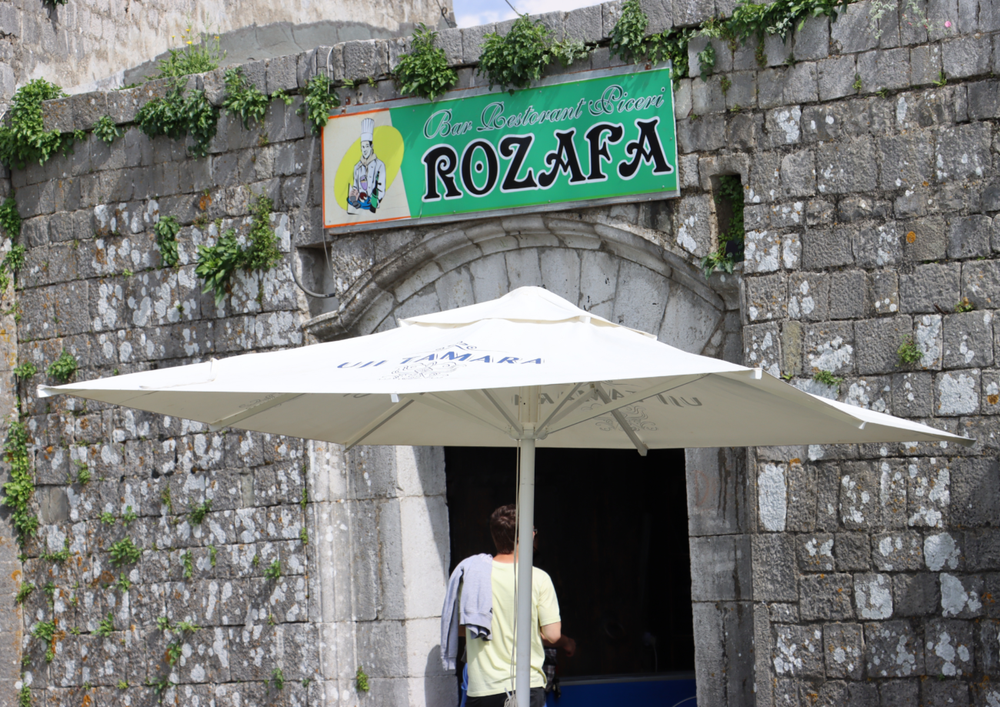
The request included six specific cases: Lëkurës Castle, Petrela Castle, Preza Castle, Rozafa Castle, Apolonia Archaeological Park and Butrint National Park – where private entities have been operating for years, providing services to visitors.
Media Amfora requested that the ministry make public the contracts, memorandums or agreements signed with these businesses, the monthly and annual costs of using public spaces, the identity of the relevant entities and any restoration or maintenance interventions carried out in the premises of the monuments, including approvals from the National Council of Material Cultural Heritage (KKTKM) and the National Institute of Cultural Heritage (IKTK).
Regarding questions about contracts, memoranda, agreements and tariffs, the ministry responded by referring only to the existing legal framework and without providing additional details.
"The fees for the provision of cultural assets are determined according to the Council of Ministers No. 857, dated 24.12.2019, 'On the determination of the procedures and criteria for competition, the form and duration of the contract and the methodology for setting fees for the provision of public cultural assets'," the ministry stated.
The institution also explained that, "an announcement has been made on the official website of the ministry regarding the opening of the competition procedure. Interested parties are invited to submit the relevant documentation to the ministry's protocol or to the electronic address [email protected], by 21.08.2025. The list of winners will also be announced on the website," the ministry added.
However, from the verification carried out by Media Amfora on the official website of the Ministry of Culture, Tourism and Sports, no public information was found related to the competition procedures or the lists of winners mentioned in the institution's response - while some of the commercial activities in the country's forts were established there decades ago.
In the "Transparency" and "Notifications" sections, no documents or data related to tariffs, contracts or entities that carry out commercial activity within cultural monuments have been published.
This verification shows that, although the ministry claims to open and publish data online, in practice the information is completely absent, deepening the lack of transparency in the administration of cultural assets. Although the ministry refers to an existing decision of the Council of Ministers, it does not provide any concrete data on the costs paid by the entities, nor any list of winners of the procedures conducted so far.
Another case of private activity is the one in the Petrela Castle, a First Category cultural monument, just a few kilometers from Tirana. In this castle, for years, a restaurant and panoramic bar have been operating, offering services to tourists and using the monument’s interior and exterior spaces for private events and organizations. On social networks and online tourist sites, the business promotes menus and events that take place “in the heart of history”, using the castle as a commercial space for rent.
However, the Ministry of Culture, Tourism and Sports, in response to Media Amfora's request, has not provided any information on the relevant contracts or the costs paid by such entities.
In the documents sent, the institution repeats the same argument as in the case of the Lëkurës Castle - that there is no signed contract or memorandum for the exercise of commercial activities within the cultural monuments.
Although private activities in the country's main castles have been carried out for years, the ministry admits that in the last five years, no new contracts have been signed with entities that use these public spaces.
"In the last five years, there have been requests for the rental of Rozafa Castle, Shkodra, and Lëkurës Castle, Saranda," the ministry said in its response.
This fact shows that commercial activities continue to develop without an updated basis from year to year, while the institution itself has not carried out any transparency or re-contracting process for the use of cultural assets.
Although the ministry does not provide transparency on the number of entities that carry out private activities in the country's archaeological forts and parks, or on the way in which this activity is carried out, it emphasizes that the use of cultural assets by private entities does not hinder scientific research in these monuments.
"..the use of cultural assets does not hinder scientific research. The relevant proposals are subject to review and decision-making by the relevant institutions," the ministry's official response states.
The most important cultural institution in the country does not explain how the commercial use of spaces within cultural monuments is specifically monitored, what the control procedures are, or whether any assessment of the maintenance of these monuments during the exercise of private activities has ever been carried out.
In the absence of public data, it remains unclear whether the economic use of cultural assets is going hand in hand with the preservation of their scientific and historical values. This lack of transparency raises serious questions about the way some of the most precious assets of Albania's cultural heritage are managed.
Editorial