At the height of the debate that the unstoppable expansion of the construction sector has opened, the government has officially acknowledged that Albania currently has 27.5 million square meters of uninhabited buildings. The data was made public in the National Building Renovation Plan. The document was drafted by the Austrian studio Kommunalkredit Public Consulting GmbH, on behalf of the Ministry of Infrastructure and Energy.
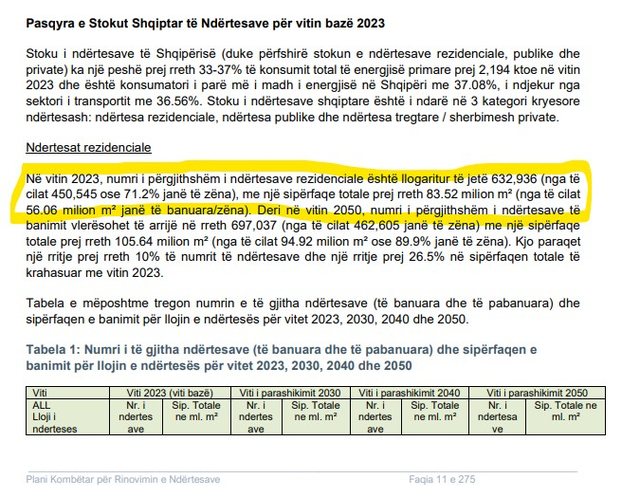
"In 2023, the total number of residential buildings is estimated to be 632,936, with a total area of approximately 83.52 million m², of which 56.06 million m² are inhabited/occupied," the accompanying document to the draft law on the renovation of the building stock states.
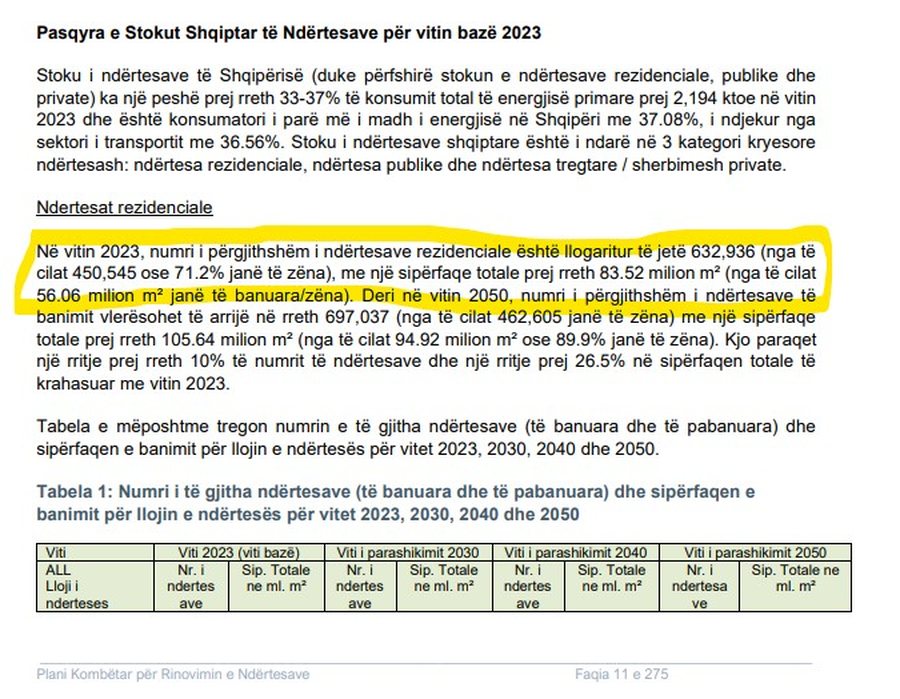
National Housing Renovation Plan
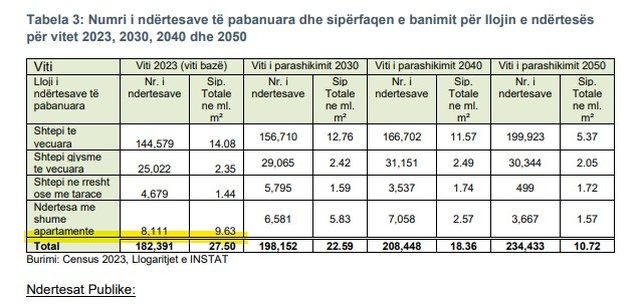
Below, the document details the categories of uninhabited buildings with tables. According to them, the majority, about 14 million square meters, are detached houses. These could be village dwellings, which have remained empty as a result of the population's displacement to urban centers, but also the massive depopulation of the country.
But in addition to detached houses, Albania also has a large stock of uninhabited housing in the multi-apartment building category. According to the document, there are currently 9.63 million square meters uninhabited in the multi-apartment building category. The vast majority of them are apartment buildings.
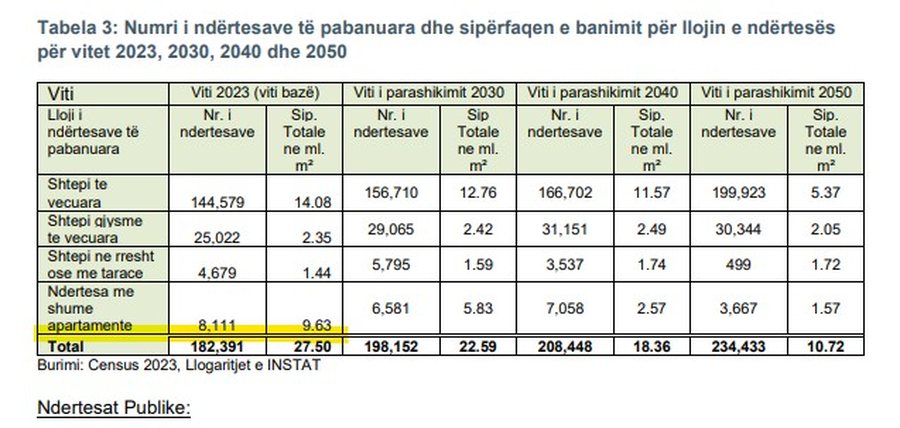
Uninhabited buildings by type
Albania has experienced a massive expansion of its residential construction sector in recent years. A flurry of permits for high-rise towers and residential complexes in urban centers, as well as coastal areas, have aggressively increased the country's construction stock. But with millions of square meters of empty housing, this situation raises questions about what is driving the Albanian economy toward concrete.
Of course, some of the constructions respond to the demand of citizens, who are looking to move to new, more modern apartments, or with larger surfaces. But despite this, the figures show that Albania has a large discrepancy between the demand for residential construction and the aggressive supply in construction.
This is because the area of vacant housing currently amounts to 31 percent of the total stock of residential built-up area. In short, one in three apartments or houses are currently uninhabited. And this figure is among the highest in Europe, turning Albania into a country of ghost towns and villages.
Editorial