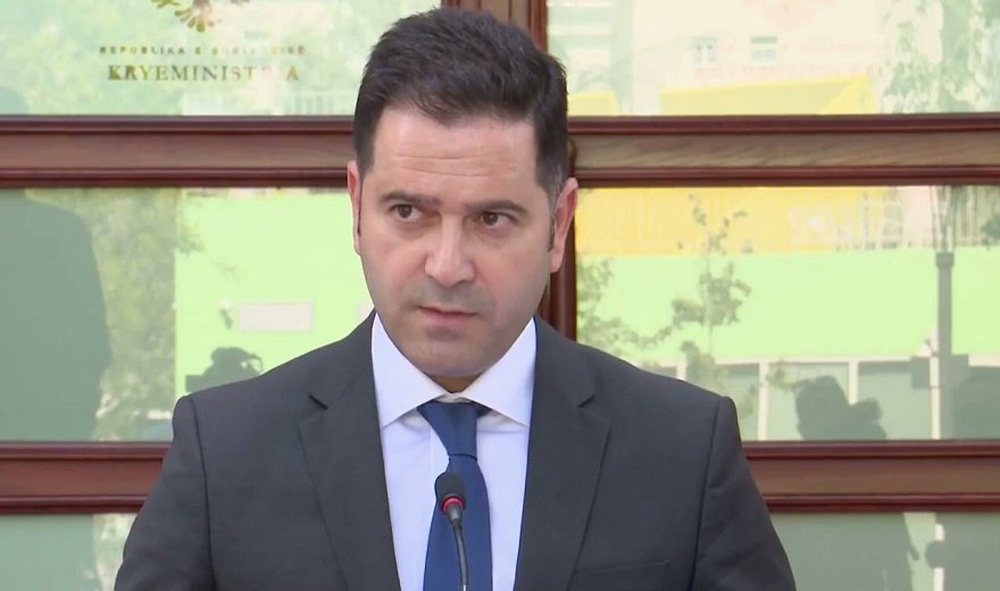
Nearly 1 billion euros will be automatically written off immediately after the draft law on the cancellation of tax and customs duties enters into force. Minister of Finance, Petrit Malaj, answered questions from the opposition in the Laws Committee about how much debt older than 10 years or created before 2014 will be forgiven.
"The debt created before 2014 is 100 billion lek, that is, from the 90s to 2014. While at the end of 2024 the debt has reached 160 billion lek. 202 thousand taxpayers who are in debt will benefit," said Malaj.
Minister of Finance, Petrit Malaj, presented to the Laws Committee the fiscal package with 8 draft laws for 2026, as well as explained the reasons that led to the adoption of this legal initiative, which will begin implementation in January of next year.
"This fiscal package, in no case does it foresee an increase in taxes, it includes a transparent, simpler, more efficient fiscal framework that supports priority sectors, as well as strengthens tax administration," said Malaj.
The main focus was on the introduction of two legal initiatives known as 'Fiscal Peace', with businesses that have unpaid tax liabilities, where debts older than 10 years are automatically erased.
"We are not undertaking a fiscal amnesty. Through fiscal peace we do not forgive any criminal liability. We do not guarantee immunity for anyone and above all we do not serve anyone who may be under investigation or in judicial proceedings. With the draft law on the Forgiveness of Tax and Customs Obligations, we close the chapter of old debts that are already prescribed. More specifically, we can say that the fiscal salary agreement, which will be implemented for the period 2026-2028," said Malaj.
Also, through the draft law "On the cancellation, extinguishment and payment of tax liabilities to the central tax administration and of liabilities payable to customs", businesses that have debts incurred from January 2015 to the end of 2024 also benefit.
"Practically, the forgiveness of the tax and customs duties, on the other hand, foresees the complete forgiveness of any debt that is older than 10 years. For debts with an age of 5 to 10 years, the possibility is offered, taking into account the financial situation, against a payment of 50% of the tax liability if this tax liability is paid by June 30, 2026, or a payment of 75% of the tax liability if this liability is paid by December 31, 2026. The business will be forgiven the rest of the debt as well as fines and late interest. For debts with an age of 0 to 5 years, fines and late interest will be erased against the payment of 100% of the tax liability, i.e. the salary by 31/12/2026. As we promised, this draft law offers opportunities to businesses and individuals to be freed from these debts," said Malaj.
The Minister of Finance also presented the draft law on the 'Peace Agreement', which aims to negotiate profits and correct financial statements.
"The peace agreement provides for escalation in the absence of tax rates, therefore, beyond an increase of 18% of taxable profit, a reduced tax rate of 5% will be applied. Entities that will be included in this agreement will have the right to request self-correction of financial statements through their review over the last three years, against payment of a 5% profit tax," the minister said.
This is the last chance that businesses have to be freed from their obligations to the state, the minister said, as then the collection of obligations by force will begin.
"We emphasize once again that with this project we do not propose to forgive unpaid obligations, whether these evaders are under criminal prosecution, or against those who have initiated a tax investigation, or for businesses that have a final decision from the court. Therefore, this is the last chance that we give debtors before coercive measures for the collection of tax obligations come into force. The tax administration, on the other hand, is continuing to work to strengthen the collection measures of force, these tax obligations, by implementing measures that go as far as blocking bank accounts, confiscations and sale of assets in order to enable tax obligations," said Malaj.
The minister also presented to the Committee 7 other draft laws part of the fiscal package, from VAT in agriculture, revaluation, favoritism for sports sponsorships to the limitation of cash payments, which were approved in principle by the Laws.
shqiptarja.com
Editorial