Esmeralda Ball
At the height of the oil price crisis, when a liter of fuel has exceeded 200 lek and remains one of the heaviest costs for any production cycle, the government has decided to remove free oil support for farmers.
A scheme that was introduced in 2021 as a salvation for agriculture disappeared five years later with the drop of a pencil.
The decision was taken by the Council of Ministers, through the National Agriculture Scheme 2026. This year's scheme no longer provides for the supply of fuel without VAT, excise duty and other taxes. Instead, the Ministry of Agriculture talks about a new, more "comprehensive" support model.
"The oil scheme as a whole is a scheme that supports the reduction of farmers' costs," declared Minister Andis Salla, emphasizing that it has evolved over the years from direct grants to financial support according to European Union standards.
But according to him, this year's change aims for more.
“The new scheme is a comprehensive scheme,” the minister said, arguing that farmers will be supported through a combination of measures, including direct subsidies and other mechanisms such as VAT auto-invoicing.
50 thousand farmers lost
Last year's data clearly shows the importance of oil support in agriculture. In 2025, around 65,000 farmers benefited from the National Scheme, while 50,000 of them were specifically supported with free oil.
This makes oil support one of the most used and most vulnerable instruments for farmers, as it directly affected one of the basic costs of production.
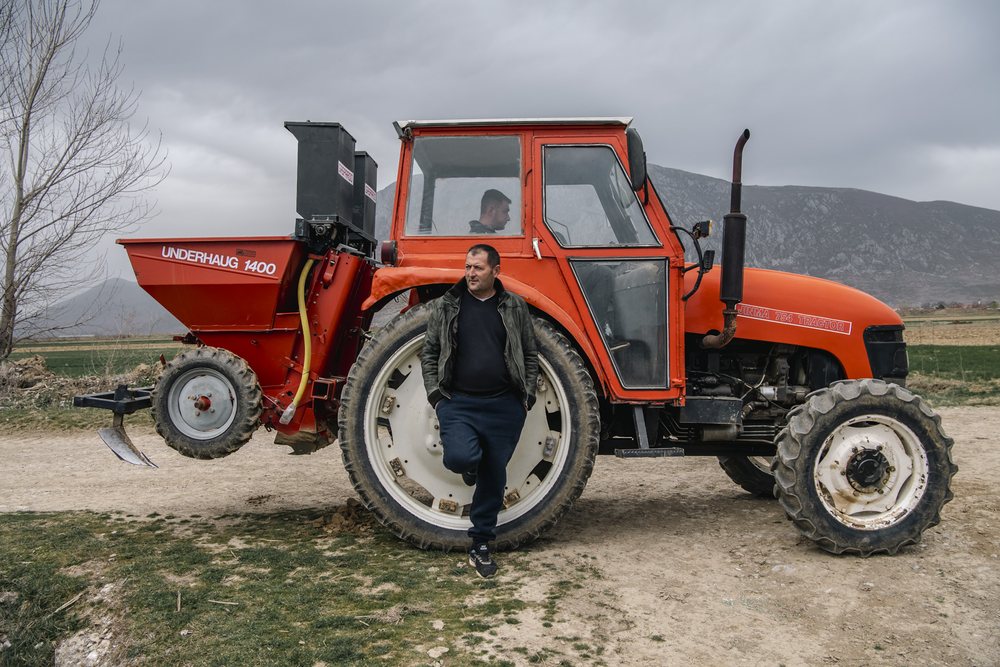
Because in agriculture, oil is used at every stage of the agricultural cycle. From land preparation and sowing in the spring, to harvesting in the summer and plowing in the fall. In this sense, any increase in its price immediately translates into higher costs for the farmer.
"I don't know with what courage such a decision was made, as it is beyond any kind of logic. We must say that the only scheme that supports (imputed) farmers to work the land has been removed. It was the only aid that farmers had," says agricultural expert Gjok Vuksani.
The diesel support scheme for farmers was launched in 2021 with around 21,000 applications, benefiting over 19,000 farmers and distributing 4.1 million liters of diesel. It also served to formalize the sector, as the benefit was conditional on the farmer providing a NIPT.
In the following years, the demand for oil increased significantly. In 2022, about 34 thousand farmers benefited, while in 2023 and 2024 over 50 thousand each year. In the following years, over 50 thousand farmers received this support. In total, for 5 years, the state budget has spent about 87 million euros to subsidize oil for agriculture.
Disappointed farmers
Rito Ahmataj, a farmer from Kafaraj, Fier, was unaware of the recent changes to the national scheme. He tells Faktoje that even the support he received previously was limited and delayed.
"A week ago I received the second installment for last year. I know how these calculations are done... from 1.5 ha I received 20 thousand new lek"
According to the farmer, the problem was not only the low level of profit, but also the timing of the money distribution. “They would give the money when the farmers had spent the money… these are planted in the spring, they give it in June-July.”
Rito is unsure about the new scheme. "It's all-inclusive, but the main thing is that it takes away oil, when a liter has gone up to 220 lek"
It even raises doubts about the distribution method. "These are incomprehensible and preferential subsidies for patronageists."
In the same vein, farmer Ahmet Kaloshi says he did not benefit from the previous scheme either. "I personally did not receive it even when the oil was free, I applied and did not benefit. They only gave it to the patronage workers."
What does the new scheme foresee?
This year's scheme provides for a series of interventions, mainly in livestock, investments and new practices in agriculture.
The thresholds for benefit have been lowered, aiming to include more farmers. For example, to receive a subsidy for cows, the minimum requirement drops from 10 to 5 heads, while the payment increases from 10 thousand to 12 thousand lek per head. The same logic is followed for sheep and goats, where the minimum number is halved from 100 to 50 heads, while the subsidy increases to 1500 lek per head. In beekeeping, the limit drops from 50 to 25 hives, while the benefit increases to 2 thousand lek per hive.
For the first time, the scheme also includes support for sows, with 7 thousand lek per head for farmers who have at least 5 of them. Meanwhile, for biological pest control, farmers can benefit from up to 70% of the cost of materials, with a ceiling of 40 thousand lek per dunyam.
Another new element is support for young people investing in agriculture, who can benefit from up to 70% of the investment value, up to 1 million lek.
In total, the scheme fund has increased to 5.2 billion lek, from 4.6 billion a year ago. But it remains to be seen whether this increase and these measures manage to compensate for the removal of a support that directly affected the basic cost of production, such as free oil.
Editorial