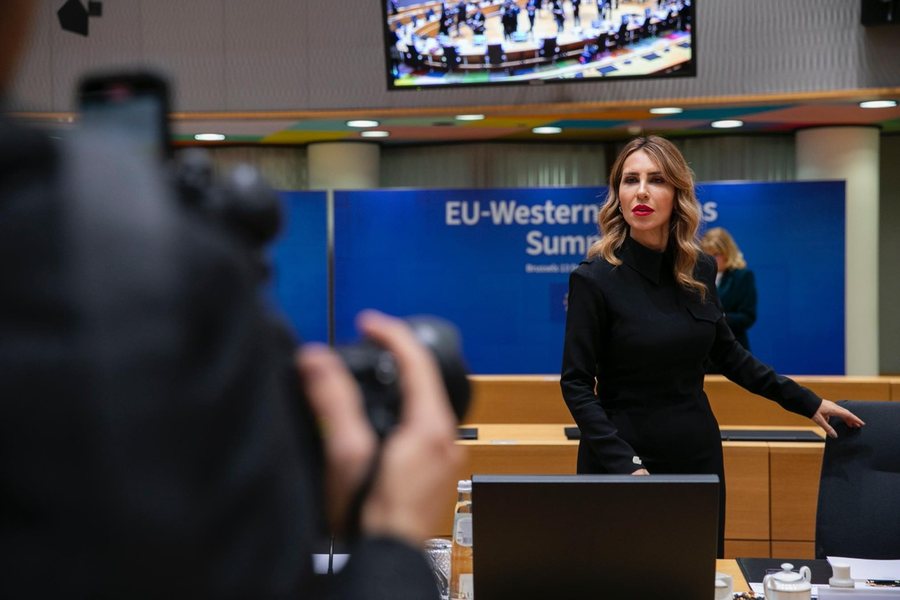
Majlinda Bregu
The Autumn Eurobarometer 2025 was published today. Many might say: “we have our own problems, we don't need to know what problems Europeans have.” This is half true. But only half.
Because what happens in Europe is not only never far from us, but often determines our political, economic and security direction. It also influences European attention to our own oppressions.
As I read the report, I was thinking about the two Europes that coexist today: Europe within and Europe without. One that is trying to grasp the message that in order to survive it must change, and the other that is still waiting to become part of it.
The message that emerges from the Eurobarometer is clear. Europeans are not asking for less Europe. They are asking for a stronger Europe.
89% want more unity within the EU and 86% expect the EU to have a stronger voice globally. At a time of wars on the border (72%), terrorist threats (67%), cyberattacks and climate risks (66%), citizens are looking for clear direction and strong leadership.
62% continue to see EU membership as a good thing. In a world that often seems unstable, faith in the European project remains strong.
What about Europe outside?!
In the Western Balkans, 64% of citizens (RCC Balkan Barometer) believe that EU membership is a good thing. After a long and often disappointing path, this is an indicator with real political weight.
During my time as head of the RCC, we have seen these trends early on and have continuously measured them through the Balkan Barometer and SecuriMeter. They have consistently shown that the orientation towards Europe is not just a political objective. For many citizens, it has become a personal life plan. Around 41% of the citizens of the Western Balkans are ready to leave the country.
And to return to "our predicament", Albanians who want to leave are higher than the regional average - 44%. When almost one in two citizens sees the future somewhere else, this is not just a statistic. It is a national alarm. An alarm for the economy, for the labor market, for confidence in the future.
In fact, in many countries in the region, citizens trust the EU more than their own institutions. The difference becomes even more apparent when we look at priorities. Within the EU, citizens think strategically: security, defense, concerns about climate change threats, and economic sustainability. In the Western Balkans, concerns are more basic: inflation, jobs, economic stability, and the functioning of the state.
In the EU, citizens express high levels of concern about several threats simultaneously:
• Wars near the EU, 72%
• Terrorism, 67%
• Natural disasters related to climate change, 66%
• Cyberattacks from countries outside the EU, 66%
• Disinformation, hate speech, deceptive content generated by AI and threats to online data, around 68–69%.
In the Western Balkans, only about 38% see the region as safe. Optimism remains limited, and concerns are related not only to geopolitical instability, including the effects of the war in Ukraine, but also to corruption, economic vulnerability, and low trust in institutions.
Disinformation is a growing concern in both realities, but it is experienced differently. In the EU it is treated as a strategic threat to democracy. In the Western Balkans it is directly linked to a heightened distrust in institutions, media and quality of life. This comparison is important because it shows two different ways of understanding Security.
For Europe inside, it is a strategic priority; for Europe outside, it is a condition for daily stability. There is also a signal that should not be underestimated - the young.
In both surveys, they are the most optimistic and the most pro-European.
Around 65% of young people in the EU are optimistic about the future of the Union and many young people in the Western Balkans see their future as European. The message is clear.
Citizens inside Europe are asking Europe to adapt to the times.
Citizens outside it are asking Europe not to hold them hostage.
Editorial