Last year, a businessman named Dritan Bellaj filed an application for action with Customs. Mr. Bellaj is the owner of the company Eurolab, which has the exclusive license to trade Lemon Soda in Albania.
Through the application, the company Eurolab asked Customs to stop the so-called parallel imports of Lemon Soda and several other products, making it the only importer of these products in Albania. The application was approved and immediately after that the price of Lemon Soda in the Albanian market skyrocketed.

Dritan Bellaj
This was the first milestone that opened a very dangerous game in the Albanian market: that of extreme monopolization.
A short while ago, the same application was made by businessman Agim Zeqo's company Albania Distribution & Development. This company holds the exclusive trading license for Red Bull and Bravo in Albania.
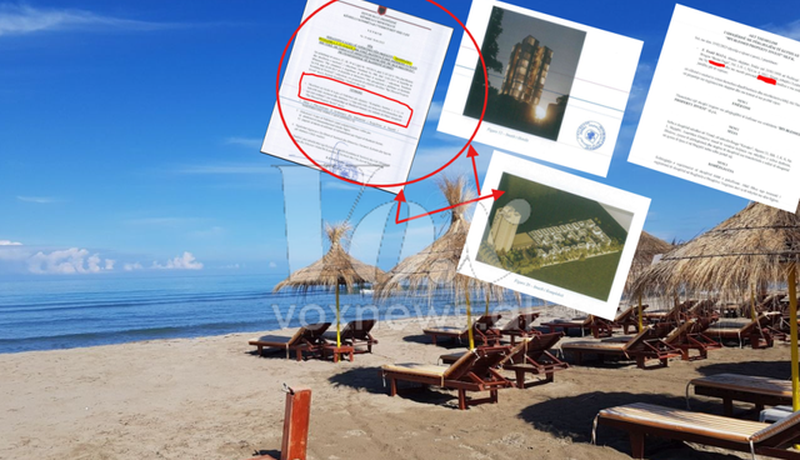
Through two special decisions, respectively 4869/2 and 4246/1, Customs has approved the application, granting the company Albania Distribution & Development the absolute monopoly to import Red Bull and Bravo into Albania.
A week ago, the General Directorate of Customs officially notified the country's customs agencies not to clear Red Bull and Bravo products from any importer other than businessman Zeqo's Albania Distribution & Development.
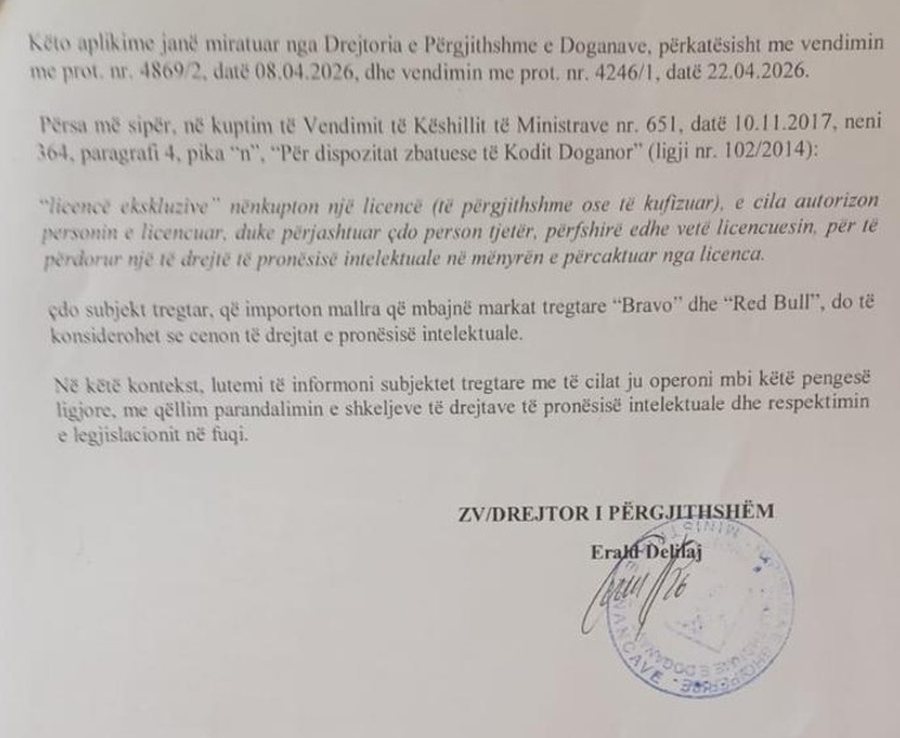
This is the document that establishes the monopoly of Red Bull and Bravo products in the Albanian market.
Absolute monopoly
Exclusive licenses generally mean that the company manufacturing a product in a foreign country sells directly to only one company in Albania.
Albania Distribution & Development has been the exclusive license holder for the distribution of Red Bull in Albania for years. But so far this license has not prevented parallel imports from other license holders abroad.
The point is, supermarket chains like Conad or SPAR import Red Bull from Conad in Italy or Spar in the Netherlands, who are also licensed by the manufacturer of Red Bull to market these products.
These are what are called parallel imports and this is the mechanism that protects consumers from the absolute monopoly of a single importer. But now the mechanism is collapsing, as the installation of single importers has begun.
Now, Conad, SPAR and any other importer are prohibited from importing and are forced to buy Red Bull from Albania Distribution & Development.
Both Eurolab and Albania Distribution have already acquired the intellectual property rights for these products, just as if they were their manufacturers.
The Complex Issue of Industrial Property
Last year, the Albanian Parliament adopted a new law on trademarks and amended the law on industrial property, aligning it with the European Union. These are the laws that are being used to install serial monopolies in the Albanian market.
Trademark protection is one of the most important issues in the EU and European directives are very strict in this regard. But there is a difference. Due to the size of the European single market, despite strong trademark protection, the installation of monopolies is impossible. Every product is freely traded in each EU member state and industrial property laws serve mostly to protect the common market from third countries such as China.
In the case of Albania, the exclusive license automatically turns into a pure monopoly, which gives the importer the power to set prices. If this phenomenon were to extend to all products for which there is a representation or exclusivity, the Albanian market would turn into a monster monopoly where 10 importing companies would set prices for almost all products on the market.
This would significantly increase prices for citizens, as being in monopoly positions, exclusive importers would have absolute power to set prices. And the only hope for citizens to escape this terrible chain would be the country's membership in the European Union, since upon becoming part of the common market, exclusive licenses automatically fall.
Customs has violated the law.
Of course, the manufacturer of a product has the right to restrict its sale. Both Albania Distribution and Eurolab, when they applied to ban other importers, should have also submitted the consent of the manufacturers of both Lemon Soda and Red Bull.
But this authorization would have to be legislated through a court decision, since ultimately commercial conflicts between civil parties are matters for the courts. Meanwhile, institutions only intervene when the interests of the state are violated.

Besmir Beja, Director General of Customs
But in this case, the state, or rather Customs, has assumed the attributes of a court by intervening in a private conflict, in which the state has no interest. On the contrary, the public interest is for the market to be competitive.
But Customs has done the opposite. Through two dubious legal decisions, under the justification of intellectual property protection, Customs has begun to install monopolies in the Albanian market, which will now come in series for many products.


Editorial