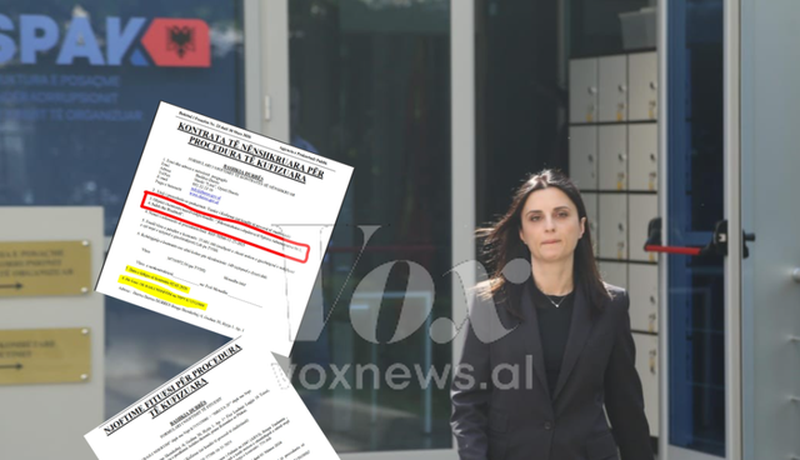
Daniel Shima, considered by SPAK as the "key" witness in explaining the affairs of the predetermination of winners in the tenders of the National Agency for Society and Information (AKSHI), turns out to be one of the main responsible for these affairs, but surprisingly, SPAK's special prosecutors have not yet officially filed a criminal charge against him.
Journalist Elton Qyno has learned that the presence of Daniel Shima in this criminal activity has also been ascertained by the Special Court of Appeal, which advises and directs the two prosecutors of criminal case No. 20/1, Altin Dumani and Bledar Maksuti, to prosecute the former deputy director of AKSHI, Daniel Shima.
Criminal prosecution should also be directed at employees Emirton Suli, Meri Manaj, Helena Papa, Denis Molla, Ingrida Luzha, Ersila Qeramixhiu, Brixhilda Sinanaj, Aurel Vrenos and Enklid Pelari, who were part of the Bid Evaluation Committee in certain tenders and who also signed several internships.
According to the investigative file, in December 2025 and January 2026, Daniel Shima was questioned 3 times at the premises of the SPAK special prosecution office.
In his testimony, Shima has shown that he, along with other members of the Bid Evaluation Committee, committed all criminal acts in predetermining the winner, guided by the Director of the National Agency for Public Procurement, Mirlinda Karçanaj, and the Deputy Director of this institution, Hava Delibashi.
According to Daniel Shimë's account, Mirlinda Karçanaj and Hava Delibashi were the two ladies from AKSHI who "piloted" the announcement of the tender winners.
While Shima, along with the members of the Bid Evaluation Committee, were simply implementing orders and directives issued by the two ladies who are already under criminal prosecution by SPAK and under the security measure of "house arrest".
But the confessions of Daniel Shimë, Emirton Suli and other persons are of a criminal nature, so the Special Court of Appeal has directed SPAK prosecutors to prosecute them as it appears that they have implemented criminal orders and created fictitious competitions.
" ...from the evidence provided in the circumstances of the case, Daniel Shima, Emirton Suli, Meri Manaj, Helena Papa, Migena Schroeder, Denis Molla, Ingrida Luzha, Ersila Qeramixhiu, Brixhilda Sinanaj, Aurel Vrenos, Enklid Pelari, in the statements made before the judicial police, provide information that the procurement procedures under investigation had predetermined results. That everything was fictitious in the implementation of these legal procedures, given that the bids were selected by order of the head and deputy head and this happened before and after 2024... " - it is stated in the documents obtained by journalist Elton Qyno.
According to the testimony of Daniel Shimë and other members of the KVO, the unfair exclusionary criteria for economic operators were dictated from outside the institution and were provided by order of the head or by the interpretation of the deputy head as criteria for the acceptance and disqualification of economic operators.
Shima also testified that the limited funds were fictitiously increased through the manipulation of bids and product price items in the estimates submitted for these public procurement procedures and that the working groups and procurement units.
Shima has shown that the Bid Evaluation Committees and the Complaints Review Committees were established and functioned only formally to legalize a pre-determined and pre-completed task.
He has often been a member of these committees and has implemented all orders coming from above, referring to Mirlinda Karçanaj and Hava Delibashi.
Given this situation, the Special Court of Appeals clarifies in its decision that: "...a legal solution will have to be addressed to all those potentially responsible for these criminal offenses in the continuation of the preliminary investigations...".
Among other things, it has emerged that in these public procurement procedures that SPAK is investigating, there are economic operators competing without bids and without documents, with the suspected reasonable criminal intent to create the idea of a real competition.
In these public procurement procedures, it turns out that there is coordination and co-ordination between companies that are in fact joint ventures, such as "Communicaton Progress sh.pk", "Horizon" sh.pk, "Soft & Solution", "First" and "Fastech".
The aim of these bidders, called from within the AKSHI to submit bids, is the formality of an economic competition that is not real but only appears to be so, with the ultimate goal of declaring one of them the winner and then dividing the profits.
On the other hand, the investigative file states that according to the statements of Daniel Shima and Emirton Suli, at least since 2023, the AKSHI had shaped such an administrative practice of the legislation in force on public procurement and the security of classified information, as to create a legal artifice to create a closed circuit in the way this institution conducted procurement competitions.
These explanations given by the two above persons clarify that, based on the classified area of the "Data-Center" of the National Agency for Security and Defense, the respective legislation was interpreted and applied as if security certification was mandatory for economic operators, even when the procurement procedure did not justify taking this measure according to the law.
These explanations clarify how the creation of this special criterion was done in coordination with the respective agency that provided the respective security certificates to economic operators.
This ensured that the operators predetermined as winners would never have competition from the open tenders submitted by other economic operators outside this closed circle, as they were not qualified because they were not equipped with a safety certificate.
Everything Daniel Shima and mainly the other member Emirton Suli says about the creation of the legal artifice of the classified area of the "Data-Center" and the dictation of the "CSI" security certification criteria was created during the time of Danil Shima's tenure and continued during the time of Hava Delibashi's tenure.
The fact that both Mirlinda Karçanaj and Hava Delibashi were aware that this was a criterion created with criminal bad faith specifically to disqualify unwanted entities from the economic procurement competition is also shown by the way in which the two public procurement procedures where the company "ABS sh.pk" controlled by Gerond Meçe had qualified were canceled in 2025.
These cancellation decisions were initiated by the contracting authority AKSHI by the "Memo" letter signed by Helena Çupi.
However, Emirton Suli's statements show that she was forced to act on this letter, even though she knew it was against the law, as she was asked to do so by Mirlinda Karçanaj and Hava Delibashi..."
This way of explaining how the AKSHI functioned in these procurement procedures finds support both from the statements of Daniel Shima and from the explanations of Helena Çupi.
The latter declares, among other things, that:
"...the interpretation that the loss of the "CSI" certificate did not legally and automatically entail the loss of the "CSP" certificate was made by Hava Delibashi and that the "Memo" letters drafted by her were approved by Karçanaj and Delibashi...".
Editorial