Capital
Albanian citizens will pay around 300 million euros in additional taxes on oil to finance the creation of a fuel security reserve.
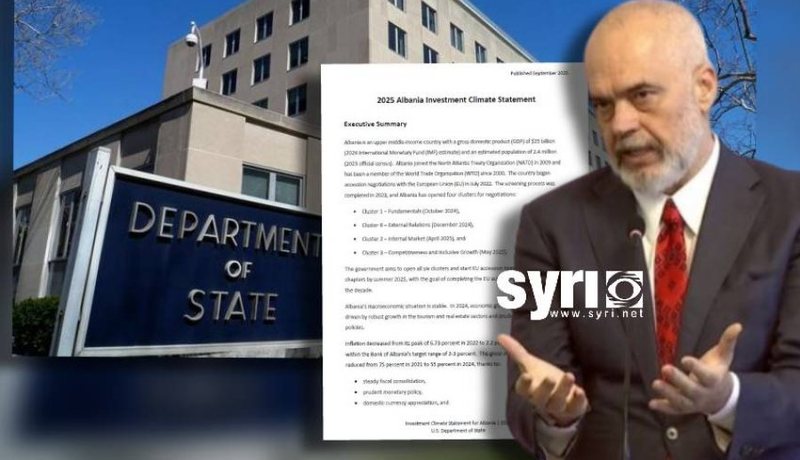
The government has reinstated the controversial bill to create a security reserve for crude oil and its by-products, which it had initially attempted to approve in 2018, but then withdrew after public opposition and staggering costs.
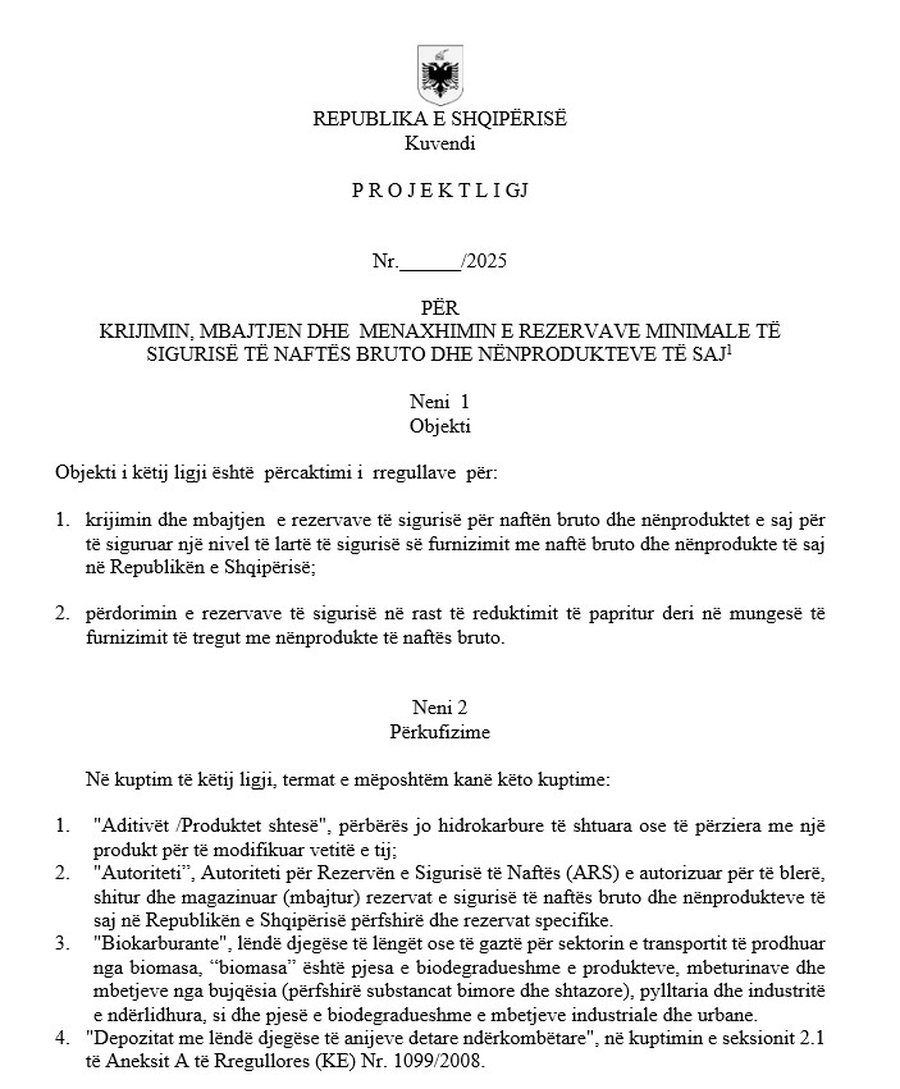
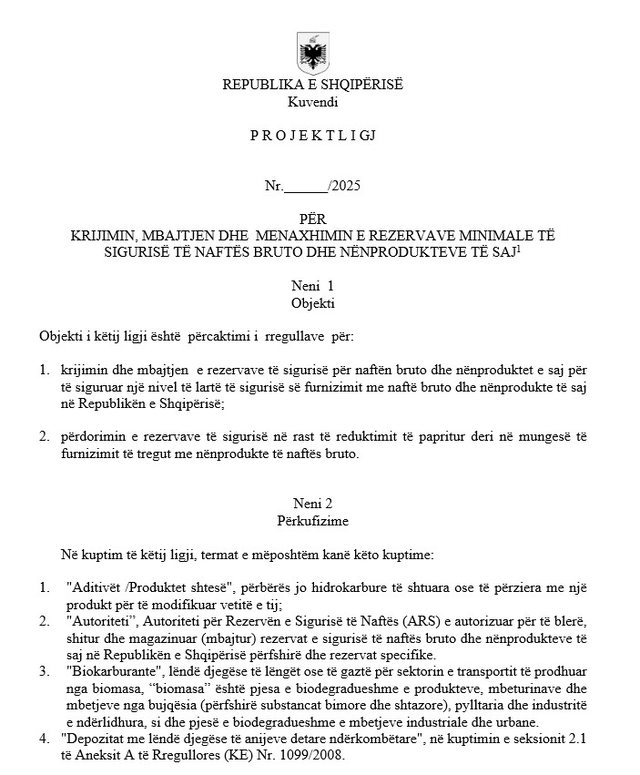
Fuel reserve draft
The draft published on the public consultation portal requires the maintenance of a national fuel reserve equal to 3 months of imports or 2 months of consumption, whichever is greater.
According to the tables published in the report attached to the law, for 2025 the mandatory fuel reserve will be 240 thousand tons, which in value translates to almost 200 million euros.
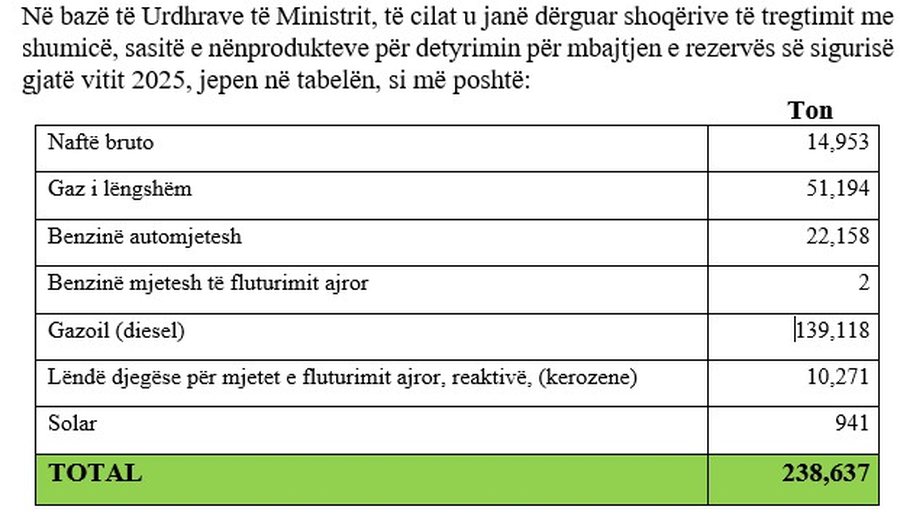
Mandatory reserve for 2025
This amount of fuel will be administered by a State Authority, which will be established specifically for this purpose under the Ministry of Infrastructure and Energy.
But how will the 200 million euros for the creation of this reserve be financed?
As if the record tax burden (among the heaviest in the world) that Albanians pay on oil were not enough, the government has written into law that it will impose a new tariff on fuel.
The fees for creating and maintaining the safety reserve will be paid by citizens in the final price of oil and gasoline, which they buy every day on the market. The amount of the fee will be determined after the approval of the law by decision of the Council of Ministers.
Although this is practically a real tax, the government has decided to call it a tariff, in order to sideline the parliament and approve the new additional burden that will fall on citizens simply and only by DCM without discussion in the Assembly.
Dizzying costs and big question marks
But the additional 200 million euros that Albanian citizens will pay to finance the purchase of the security reserve is only one of the cost items. The bill for this operation is much larger than that, as it will also include the infrastructure necessary to store the reserve, but also administrative costs such as labor and transportation.
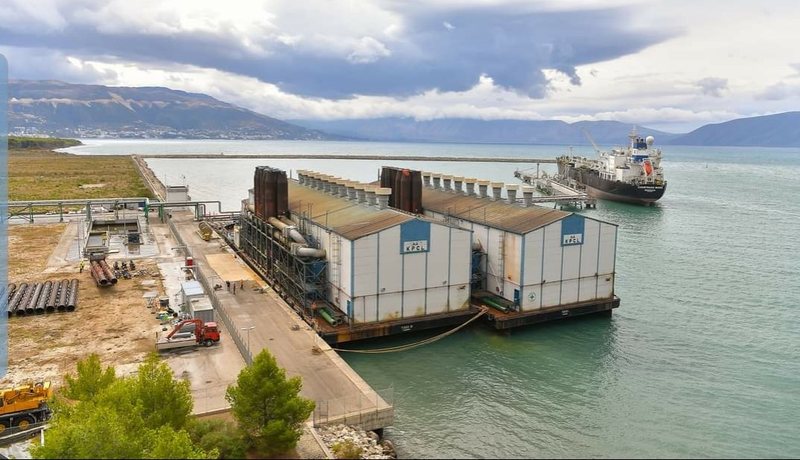
The law states that the government will contract for leased warehouses to hold the reserve amount.
"The storage facilities of Economic Operators, contracted for the storage of safety reserves, shall be equipped with technical certification for compliance with the norms and technical conditions for the storage of crude oil and its by-products according to the legal provisions in force," the draft law states.
Although it remains unclear whether such large storage capacities exist in Albania, the second question is related to cost. Currently, the cost of renting fuel storage facilities is a minimum of 10 euros per ton per month.
This means that to maintain the 280,000 tons of fuel reserves that the government is requesting this year, a minimum of 2.8 million euros per month is needed. If transportation and labor costs are added to these, the bill for maintaining the reserve will be significantly higher than the 200 million euros figure. But it doesn't end there.
How will the Authority buy and sell oil?
Fuels have the property of expiring and their reserves must be renewed by selling existing quantities and purchasing new quantities. This means that the state authority will buy and sell oil on the market for the needs of the reserve.
Albania has a similar experience with electricity, where state-owned companies buy and sell energy. What happens is that they buy it expensively and sell it cheaply, losing public money, which is charged as losses to the citizens.
This is a foolish operation with stratospheric costs, although the government says that the creation of the reserve is a condition of the European Union. However, the EU directives do not determine the form of holding the reserve. It can be state-owned, but it can also be held by private companies, physically in their warehouses, at gas stations, or on commissioned ships.
Moreover, this draft law raises doubts that it will lead to money for government clients. The law states that the Authority will rent deposits from private individuals. In parallel, it can delegate this function directly to private individuals.
The Authority, for a certain period, can delegate tasks related to the storage and management of security reserves, with the exception of the sale and purchase of specific reserves, to economic operators, based on an Agreement concluded between the Authority and the economic operator," the law states.
So, between the authority and the private individuals who own the warehouses, another private realtor can come in, who rents the warehouses from the private individuals and bills the government at a higher price. Business for the government's Rons.
Editorial